

Passive income falls into three broad categories: capital-based (dividends, interest, ETF distributions), asset-based (rental property, digital products, royalties), and operational or semi-passive (affiliate revenue, peer-to-peer lending, option premiums). Common examples across these categories include dividend and ETF income, direct rental property, listed real estate funds, ebooks and online courses, royalties from music or stock images, advertising and affiliate revenue from blogs or YouTube channels, crowdlending, and covered-call option strategies. For Swiss residents, the most important tax rule to know upfront is this: private capital gains on movable assets such as shares and funds are generally tax-free, while dividend distributions and interest income are taxed as ordinary income. Swiss withholding tax applies to domestic dividends but is typically reclaimable through the annual tax return when correctly documented. The Swiss Federal Tax Administration (ESTV) is the governing authority on all of these points.
- Capital-based: dividends, bond interest, ETF distributions, money market funds
- Asset-based: rental property, listed real estate funds, digital products, royalties, licences
- Operational/semi-passive: affiliate and advertising revenue, peer-to-peer lending, covered calls, minor partner stakes
1. Dividend and ETF income
Owning shares or ETFs that pay regular distributions is the most accessible starting point for most investors in Switzerland. You invest capital, the underlying companies pay dividends, and the ETF or fund passes those distributions to you. For Swiss residents, ETFs provide immediate diversification with low fees and are often the default vehicle for capital-based passive income, particularly for those starting with modest sums.
A practical note on fund domicile:
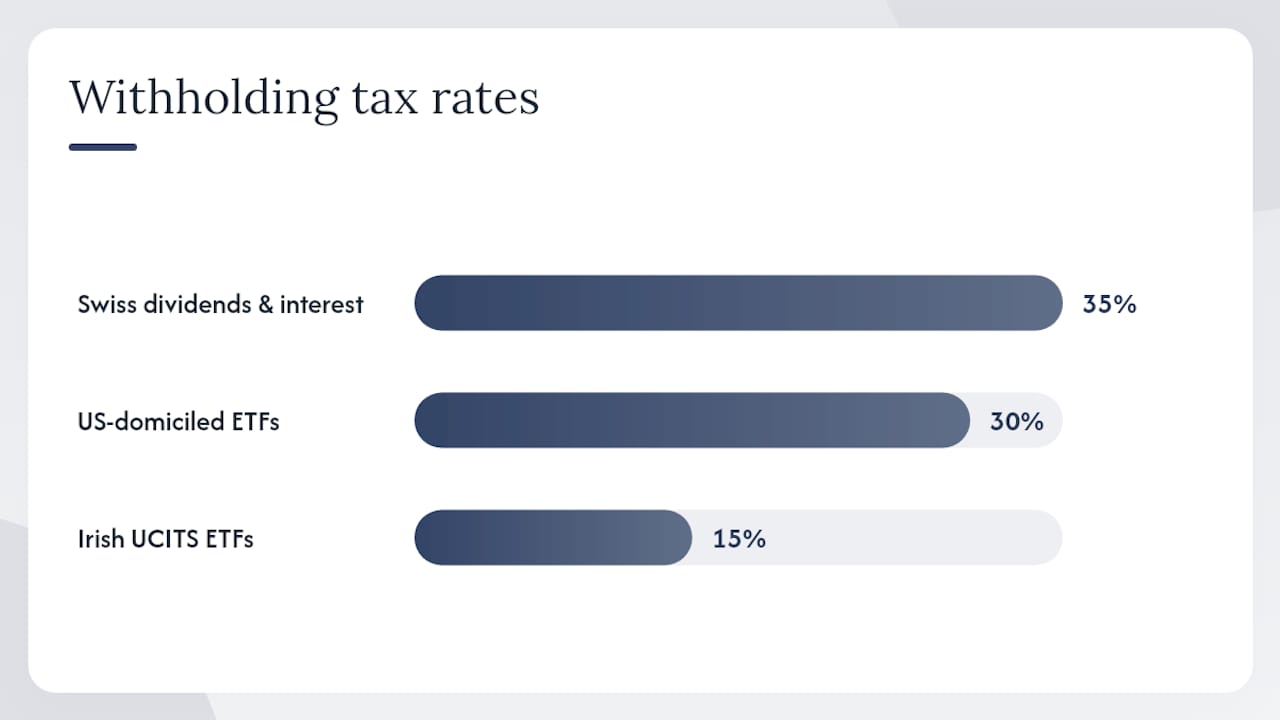
. Over decades, that 15-percentage-point gap compounds into a material difference in net income. Most Swiss investors are better served by UCITS share classes listed on the SIX Swiss Exchange or Euronext Amsterdam.
For a dividend portfolio sized for retirement, the priority shifts from accumulation to reliable distributions, which means progressively favouring higher-yield distribution ETFs and maintaining a cash buffer to avoid sequence-of-returns risk.
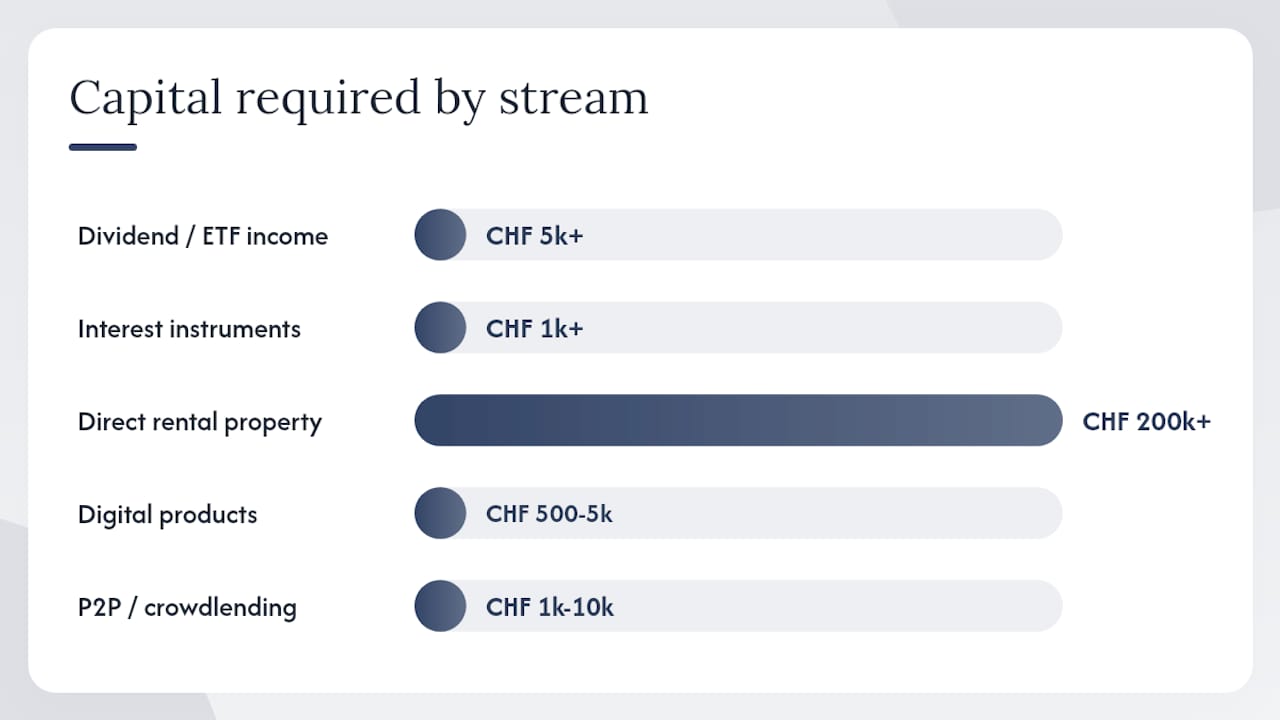
Typical capital required: CHF 5,000 upwards. Time to set up: a few days via a regulated Swiss broker. Risk level: medium. Expected returns: broadly 2%–5% yield depending on allocation. Liquidity: high. Swiss tax: dividends are taxable as ordinary income; capital gains on the ETF units themselves are generally tax-free.
2. Interest-bearing instruments
Bonds, savings accounts, and money market funds generate interest income without requiring active management. Swiss cantonal banks and PostFinance offer savings products, while the Swiss bond market and international bond ETFs provide broader options. Interest is taxed as ordinary income under Swiss law, and Swiss withholding tax applies to interest from Swiss-domiciled bonds, again reclaimable via the tax return.
Typical capital required: CHF 1,000 upwards. Risk level: low to medium. Expected returns: varies considerably with rate environment and credit quality. Liquidity: high for bond ETFs; lower for fixed-term deposits.
3. Direct rental property
Owning residential or commercial property and letting it to tenants is one of the most established real estate passive income strategies globally, and Switzerland is no exception. Rental income is taxed as ordinary income, and the imputed rental value (Eigenmietwert) system means even owner-occupiers face a notional income charge. Mortgage interest and maintenance costs are deductible, which partially offsets the tax burden.
The entry barrier is high: Swiss property prices in major cities mean a typical investment property requires substantial capital and a significant mortgage. Ongoing management, tenant relations, and maintenance mean this is not truly passive without a property manager. Capital gains on property are subject to cantonal real estate gains tax, which differs from the general capital gains exemption that applies to movable assets.
Typical capital required: CHF 200,000+ equity. Time to set up: months. Risk level: medium to high (leverage, illiquidity). Expected returns: gross rental yields of roughly 2%–4% in Swiss cities. Liquidity: very low.
4. Listed Swiss real estate funds and REITs
Listed Swiss real estate funds offer rental income exposure without the burden of direct property management. Funds such as those listed on the SIX Swiss Exchange invest in diversified portfolios of Swiss residential and commercial properties and pay regular distributions. They trade like shares, so liquidity is far higher than owning property directly.
Distributions from Swiss real estate funds are generally taxable as income. The agio (premium to net asset value) on Swiss listed funds can be significant, so buying at elevated premiums carries valuation risk. For international clients, this is often a cleaner entry point to Swiss real estate than direct ownership.
Typical capital required: CHF 1,000 upwards. Risk level: medium. Expected returns: distribution yields typically in the 2%–3.5% range. Liquidity: high (exchange-traded). Swiss tax: distributions taxable; capital gains on fund units generally tax-free for private investors.
5. Digital products and online courses
Creating an ebook, online course, software tool, or template library is a genuinely scalable form of income. The work happens upfront; once the product exists and a distribution channel is established, sales can continue with minimal ongoing effort. Platforms such as Teachable, Gumroad, or Udemy handle payment processing and delivery globally.
For Swiss residents, income from digital product sales is taxable as ordinary income. If sales volume is significant, VAT registration may be required. Sole traders and small businesses should keep clear records of revenue and platform fees from day one. This category suits professionals with specialist knowledge — financial coaches, designers, language teachers, and consultants — who can package their expertise once and sell it repeatedly.
Typical capital required: CHF 500–5,000 (production and marketing). Time to set up: weeks to months. Risk level: low to medium (market demand risk). Expected returns: highly variable; a well-positioned course can generate CHF 1,000–10,000+ per month, but many products earn far less. Liquidity: immediate (digital delivery). Swiss tax: ordinary income; VAT considerations apply above thresholds.
6. Royalties from creative and intellectual property
Royalties from music, photography, stock images, written works, or patents represent a classic asset-based income stream. Once a piece of work is licensed, the creator receives a fee each time it is used. Platforms such as Shutterstock, Getty Images, and music licensing services distribute royalties automatically.
Swiss tax treats royalty income as ordinary income. If the intellectual property is held through a business structure, different rules may apply. For most individuals, royalties are declared on the standard Swiss tax return alongside other income.
Typical capital required: time investment rather than financial capital. Risk level: low once established, but demand can decline. Expected returns: modest for most creators; significant for those with widely used works. Liquidity: high (regular payments from platforms).
7. Affiliate and advertising revenue
Blogs, YouTube channels, podcasts, and newsletters can generate income through advertising networks (such as Google AdSense) and affiliate programmes (such as Amazon Associates or financial product referral schemes). The income is genuinely passive once content is published and ranked, though building an audience to the point where revenue is meaningful takes sustained effort over months or years.
For Swiss residents, this income is taxable as ordinary income. If the activity is conducted at a commercial scale, it may be classified as self-employment, which carries implications for AHV/IV social insurance contributions. Keeping clear records of all platform payments is necessary for accurate tax declarations.
Typical capital required: CHF 500–3,000 (hosting, equipment, tools). Time to set up: 6–24 months to meaningful income. Risk level: medium (algorithm and platform dependency). Expected returns: highly variable. Liquidity: high.
8. Peer-to-peer lending and crowdlending
Peer-to-peer (P2P) lending platforms connect investors directly with borrowers, generating interest income. In Switzerland, platforms such as Creditgate24 and Lend operate under FINMA oversight. Interest income from P2P lending is taxable as ordinary income. Default risk is the primary concern: diversifying across many loans and using regulated platforms reduces but does not eliminate the risk of capital loss.
Income investing strategies that combine dividend equities, bonds, and real estate can incorporate P2P lending as a complementary yield source, though it requires more active monitoring than a passive ETF portfolio.
Typical capital required: CHF 1,000–10,000 to achieve meaningful diversification. Risk level: medium to high (credit and platform risk). Expected returns: interest rates vary by platform and borrower risk profile. Liquidity: low to medium (loan terms are fixed).
9. Covered calls and option strategies
Writing covered calls on shares you already own generates recurring premium income. Each time you sell a call option, you receive a premium immediately; if the option expires worthless, you keep the premium and repeat the process. This strategy suits investors who hold a concentrated equity position and are comfortable capping their upside in exchange for regular income.
The tax treatment in Switzerland is nuanced. Option premiums received may be treated as ordinary income rather than capital gains, depending on the frequency and scale of activity. Investors who trade options systematically risk being reclassified as professional traders, which removes the capital gains exemption. This is an area where specialist advice is worth seeking before committing.
Typical capital required: CHF 50,000+ (you must own the underlying shares). Risk level: medium (capped upside, retained downside). Expected returns: premiums of roughly 1%–3% per month on the notional value are achievable in volatile markets, but this is not guaranteed. Liquidity: high (options are exchange-traded).
10. Business equity and minor partner stakes
Holding a minority stake in a private business, or receiving profit distributions as a silent partner, can generate passive income without day-to-day involvement. In Switzerland, this is common in family businesses and small enterprises. Distributions are taxed as dividend income; the 35% withholding tax applies and is reclaimable.
The risk profile is higher than listed investments: private equity is illiquid, valuations are opaque, and minority shareholders have limited recourse if management decisions go against them. This suits investors who have an existing relationship with a business and can conduct proper due diligence.
Typical capital required: highly variable. Risk level: high. Liquidity: very low.
11. Licencing intellectual property or a business model
If you own a patent, a brand, a proprietary process, or a franchise model, licencing it to third parties generates royalty or licence fee income. This is common in technology, pharmaceuticals, and branded consumer goods. For individuals, it might mean licencing a software tool, a training methodology, or a proprietary recipe.
Swiss tax treats licence fees as ordinary income. If the IP is held in a Swiss company, the participation exemption and IP box regimes may reduce the effective tax rate, but these are corporate-level considerations rather than personal income planning.
Typical capital required: the cost of creating or acquiring the IP. Risk level: medium (licensee default, IP infringement). Liquidity: low (contractual terms govern payment timing).
Comparison of passive income streams
How do you choose the right passive income stream for your situation?
The right choice depends on four variables: capital available, time you can realistically commit, risk tolerance, and your Swiss tax and residency position. Start there, not with the stream that sounds most appealing.
Work through this checklist before committing to any stream:
- Monthly income target. What net monthly amount would make this worthwhile? A CHF 500 monthly target from dividends at a 3% yield requires roughly CHF 200,000 in capital. Use a dividend income calculator to model your specific scenario.
- Regulatory and tax constraints. Non-residents, expats, and those with cross-border income face additional complexity. Financial planning for expats in Switzerland covers the key residency and reporting considerations.
Red flags to avoid: high upfront leverage on property without stress-testing interest rate rises; platforms promising fixed high returns without regulatory authorisation; businesses described as “passive” that actually require 20+ hours per week to sustain; and any structure that obscures the tax reporting obligation.
Pro Tip: Combine one capital-based stream (such as a UCITS ETF portfolio) with one asset-based stream (such as a digital product or licensed work). The ETF provides liquidity and steady compounding; the asset-based stream adds a higher-variance income layer that can grow independently of market conditions.
Swiss tax and legal rules you need to know for passive income
The single most important rule for Swiss residents is the distinction between capital gains and income. Private capital gains on movable assets — shares, funds, bonds — are generally tax-free, while dividends and interest are taxed as ordinary income at your marginal rate. This distinction shapes every investment decision.
Swiss tax practice confirms that the income tax base includes interest, dividends, and rental income, while capital gains on privately held movable assets remain an important exception in most cantons. The exception does not apply to real property (cantonal real estate gains tax applies) or to investors reclassified as professional traders.
Key rules by income type
Dividends: Swiss withholding tax of 35% is deducted at source on domestic dividends. You reclaim it by declaring the gross dividend on your Swiss tax return and attaching the relevant documentation (typically a broker statement or Verrechnungssteuer certificate). Foreign dividends are taxed at your marginal rate; the withholding applied by the source country may be partially offset via double tax treaty relief, but the mechanics vary by country.
Interest: Treated identically to dividends for Swiss residents. The 35% withholding on Swiss-source interest is reclaimable; foreign interest is declared gross.
Rental income: Declared as ordinary income. Allowable deductions include mortgage interest, maintenance, insurance, and property management fees. The imputed rental value system means owner-occupiers must also declare a notional income figure, though this is set to be reformed.
Royalties and digital product income: Declared as ordinary income. If the activity constitutes a commercial enterprise, AHV/IV social insurance contributions apply on net profit.
P2P lending interest: Ordinary income, declared on the tax return. No withholding mechanism applies for most Swiss platforms, so the gross interest received is declared directly.
Fund domicile and withholding leakage: Irish-domiciled UCITS ETFs face 15% withholding on US dividends, versus 30% for US-domiciled ETFs. For Swiss investors holding dividend-paying equity ETFs over the long term, choosing UCITS share classes listed on SIX or Euronext is a straightforward way to reduce leakage.
Pro Tip: For tax-efficient wealth structuring in Switzerland, choosing Irish-domiciled UCITS ETFs over US-domiciled equivalents is one of the simplest structural decisions that reduces withholding leakage without any complex arrangement.
This article provides general information, not professional tax or legal advice. Confirm current rules with the Swiss Federal Tax Administration (ESTV) or a qualified Swiss tax adviser before making decisions.
Common risks and mistakes when building passive income
The most frequent errors are not market-related. They are structural: too much leverage, underestimating the time required, ignoring tax obligations, concentrating in one stream, and falling for platforms that are not properly regulated.
Market and concentration risk is the most obvious. A dividend portfolio concentrated in a single sector or a single currency can see income drop sharply in a downturn. Diversifying across income types — capital-based ETFs, one asset-based product, and perhaps a small P2P allocation — reduces the impact of any single stream underperforming.
Regulatory and tax risk catches many people off guard. Systematic option writing, high-frequency P2P activity, or running a large-scale digital business can trigger reclassification as professional trading or self-employment, removing the capital gains exemption and adding AHV contributions. The threshold is not defined by a single bright-line rule; it depends on frequency, leverage, and the proportion of income derived from the activity.
Liquidity risk is particularly relevant for direct property and private equity. Locking a large proportion of your net worth into illiquid assets without a separate cash reserve is a common mistake among first-time property investors.
Platform and counterparty risk applies to P2P lending and some digital platforms. Using FINMA-supervised platforms and avoiding any service promising guaranteed returns above prevailing market rates are basic safeguards.
Pro Tip: When your passive income strategy involves complex cross-border tax positions, high-volatility income streams such as option writing, or real estate with non-resident ownership rules, consult a FINMA-authorised adviser before proceeding. The cost of advice is almost always lower than the cost of a structural mistake discovered at tax time.
Key takeaways
The most reliable passive income strategy for Swiss residents combines capital-based ETF income (tax-efficient, liquid, and low-maintenance) with one asset-based stream matched to your skills and capital.
Why a tax-aware approach to passive income matters more than most people realise
The conventional framing of passive income focuses almost entirely on yield: find the highest-returning asset, invest, collect. What that framing misses is that in Switzerland, the structure of your income matters as much as the amount. Two investors earning the same gross return can end up with materially different net income depending on whether they hold accumulating or distributing ETFs, whether their funds are domiciled in Ireland or the US, and whether their option-writing activity crosses the threshold into professional trading.
The capital gains exemption for private investors is genuinely valuable, and it is worth organising a portfolio to preserve it. That means being deliberate about frequency of trading, avoiding excessive leverage, and keeping clear records that demonstrate the private investor character of your activity. It also means not treating the exemption as permanent or unconditional: the Swiss tax authorities assess the facts of each case, and the line between private investor and professional trader is drawn on substance, not intention.
For families and women building long-term financial independence in Switzerland, the most durable approach is usually the least complicated one: a diversified UCITS ETF portfolio generating dividend and interest income, one asset-based stream that matches existing skills, and a clear tax filing discipline from year one. Complexity adds cost and risk; simplicity compounds.
How Marmot Finance helps you build a passive income strategy
Marmot Finance is the practical alternative to building a passive income plan alone, particularly for families and international clients navigating Switzerland’s tax and regulatory environment. As a FINMA-accredited wealth manager focused exclusively on women and families in Switzerland and Europe, Marmot designs personalised, tax-aware investment strategies that integrate passive income planning with pension optimisation and long-term wealth structuring.
Where most generic guides stop at “buy an ETF,” Marmot goes further: selecting the right fund domicile, structuring accounts to preserve the capital gains exemption, and coordinating passive income with AHV contributions and pillar 3a planning. For digital creators and entrepreneurs, Marmot’s financial coaching service helps structure income from digital products and royalties correctly from the outset, avoiding the tax surprises that catch many self-employed clients later.
A typical starting engagement involves a discovery call, a review of your current assets and income sources, and a personalised strategy covering one or two passive income streams alongside your existing pension and savings plan. To take the first step, book a discovery call or start with the Money Makeover Quiz to get a clear picture of where you stand today.
Useful sources and further reading
- A defining feature of the Swiss tax system for individuals (PwC)
- 11 Passive Income Ideas to Increase Your Cash Flow
- Passive Income (CH) – Ideas & Taxes (Budgethub)
- Living and working in Switzerland | Deloitte Switzerland
- Dividend portfolio for retirement: the Swiss wealth manager’s strategy (2026)
- Investing in Switzerland: The Complete 2026 Guide | ibani
- Predictable returns through income investing (Finanz‑CH)
Recommended
- Financial Planning for Expats in Switzerland | Marmot Finance
- Finanzplanung für Expats in der Schweiz | Marmot Finance
- Best Asset Classes for Women Investors in Switzerland | Marmot Finance
- Tax-Efficient Wealth Structuring in Switzerland: Investor guide | Marmot Finance

.webp)





.jpeg)




.png)

.svg)


