

Women in Switzerland control a growing share of private wealth, yet the wealth management industry continues to design products and services around a career trajectory that does not reflect most women’s lives. The gender gap in wealth is not simply a pay story. It runs deeper, into pension accumulation, investment confidence, and the structural assumptions baked into financial advice. The result is a significant segment of investors who are poorly served, often misunderstood, and increasingly aware of both.
Key facts about women as investors in Switzerland:
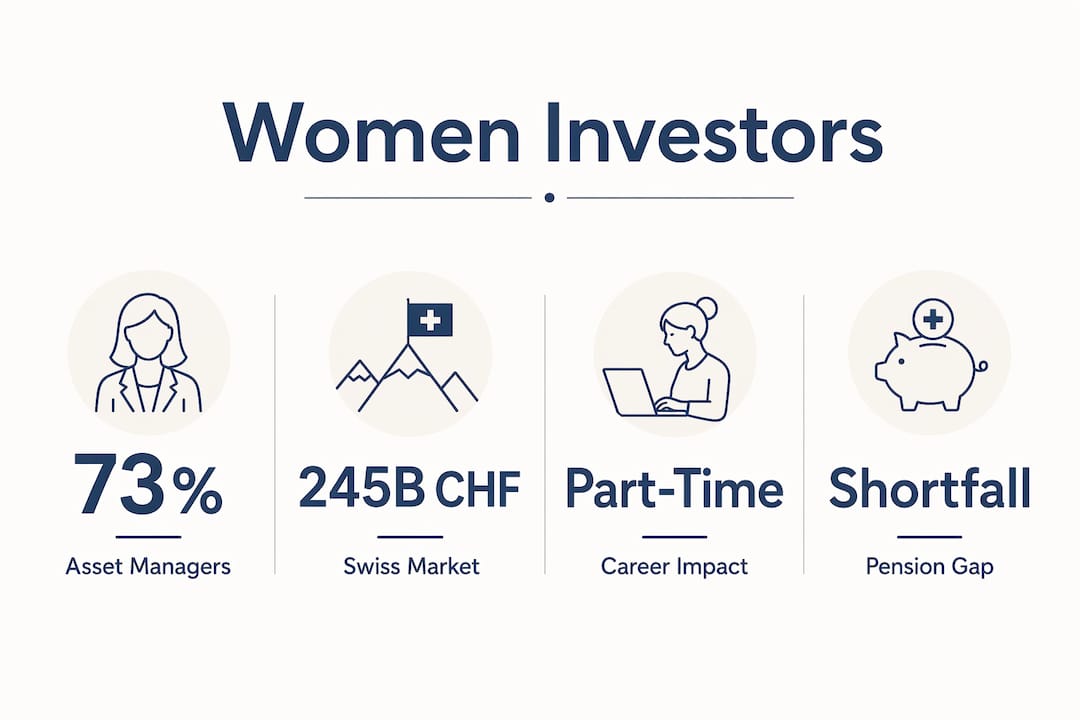
- Women in Switzerland face a gender pension gap of 29.9%, receiving on average CHF 37,267 annually versus CHF 53,153 for men.
- Women receive occupational pension plans less often than men (53.7% vs. 73.1%) and when they do, those pensions are on average 42% lower.
- Almost two thirds of Swiss women report financial challenges, compared to 52% of men.
- Security matters far more to women than long-term accumulation or returns when managing money.
- Women represent a large addressable market in Switzerland, yet remain underserved by a system built primarily for affluent men.
Why women investors in Switzerland face a harder road
The pension gap is the most visible symptom of a broader structural problem. Career breaks for family reasons, part-time work, and interrupted employment histories all reduce contributions to the second pillar, Switzerland’s occupational pension system. Women interrupt employment more often and work part-time at higher rates than men, primarily for family reasons, and the financial consequences compound over decades.
The gap is sharpest among married pension recipients, though this partly reflects the pooling of household income within couples. Among divorced women, the gap narrows but financial vulnerabilities remain. Switzerland’s gender pension gap sits above the European average, making it one of the more pronounced on the continent.
Beyond pensions, women face institutional barriers that go largely unaddressed. A lack of trust in banks, uncertainty about investment risk, and the feeling of knowing too little are cited by roughly one in five Swiss women as reasons for not engaging with investing. These are not personal failings. They reflect an industry that has not built products or communication styles around women’s actual circumstances.
Key challenges women investors face in Switzerland:
- Pension accumulation gaps caused by career breaks and part-time work.
- Financial products designed around continuous, full-time employment histories.
- Trust deficits with traditional financial institutions.
- Perceived complexity and lack of accessible, unbiased education.
- A gender wealth gap in Switzerland that is larger than in comparable countries such as Australia.
How wealth managers can genuinely serve women investors
The starting point is product design. A 2021 BNY Mellon study found that 73% of asset managers admit their products are built primarily for men. Closing that gap means creating pension plans that accommodate career interruptions, investment products aligned with women’s values, and fee structures that do not penalise smaller or irregular contributions.
Trust is built through transparency and personalisation, not through pink branding. Women’s primary motivation for engaging with finances is stability and security, with 52% wanting to remain financially stable despite rising costs and 49% saving for a more secure future. Advice that speaks to those motivations directly, rather than defaulting to return-maximisation language, tends to land differently.

Pro Tip: Avoid “female-investing washing.” Offering expensive education courses or superficially relabelled products does not serve women’s financial needs. Genuine value means addressing saving, debt management, and risk before encouraging investment, and pricing those services fairly.
Digital tools and hybrid advisory models extend reach to women who may not feel comfortable walking into a traditional private bank. The financial life-cycle of a woman in Switzerland looks different from the standard model, and the tools used to support it should reflect that.
Strategic actions for wealth managers:
- Design flexible pension products that account for part-time work and career breaks.
- Use plain, direct communication that prioritises security and stability over jargon-heavy return projections.
- Offer hybrid digital and in-person advisory to lower the barrier to entry.
- Price education and coaching services fairly, avoiding exploitative course fees.
- Build community and peer-learning into the client experience.
Why financial education is the long-term lever
Financial literacy is foundational, but only when it is genuinely accessible and unbiased. As Therese Faessler of Invested.ch has noted, encouraging women to invest before they understand saving, debt management, and risk is counterproductive. Education must build in the right sequence, and it must be priced fairly. Charging CHF 3,000 for a financial education course before a woman has any investment literacy defeats the purpose entirely.
Community platforms and literacy programmes targeted at women improve confidence and participation in financial markets. Platforms such as iconomix.ch, the Swiss National Bank’s economic education resource, provide a starting point for school-age financial literacy. Beyond formal education, peer communities where women can share experiences, follow other investors, and find mentorship create the sustained engagement that one-off seminars cannot.
Education programmes that work for women share several characteristics:
- They address saving and debt management before investment.
- They are priced accessibly, not as premium products.
- They treat women as informed adults, not as uneducated men.
- They incorporate community and role models alongside content.
- They connect financial decisions to personal values, not just financial returns.
Women have a different understanding of value than the standard financial model assumes. Providers who recognise that women care about societal resilience alongside personal financial resilience, and who build that into their educational offer, tend to see stronger long-term engagement.
Marmot Finance: built specifically for women in Switzerland
Marmot Finance is a FINMA-licensed Swiss wealth manager dedicated to serving women investors through a hybrid model that combines digital tools with personal advisory. It is one of the few wealth managers in Switzerland built from the ground up around the financial realities women actually face, rather than retrofitting a male-oriented model with female branding.
Key features of Marmot Finance’s approach:
- Investment entry at accessible levels, making professional wealth management available beyond the traditional high-net-worth threshold.
- Globally diversified investment products designed specifically for women, typically unavailable to retail investors.
- Low investment costs and fees, with transparent pricing.
- A network of female financial coaches, planners, and a peer community.
- Educational resources and financial coaching integrated into the client experience.
- Over 350 women have already worked with Marmot Finance to improve their financial situations.
Marmot Finance addresses the CHF 245 billion addressable market that Swiss women represent, a segment that traditional wealth managers have consistently underserved. For women seeking expert wealth management that reflects their career patterns, values, and long-term goals, Marmot Finance offers a credible, regulated alternative to the standard private banking model.
Who are women investors in Switzerland?
Swiss women investors are not a monolithic group. Demographically, they span working professionals managing career interruptions, divorced or widowed women taking sole control of household finances for the first time, and high-earning women in dual-income households who want independent financial planning. Each group carries distinct needs and different levels of prior engagement with financial services.
Psychographically, the UBS Women’s Perspectives 2026 study reveals that security and stability dominate women’s financial motivations, with 46% also wanting to make confident, self-directed decisions about their money. Women are not risk-averse by nature; they are risk-aware, and they want advice that respects that distinction. The investment advice that resonates tends to be grounded, transparent, and connected to life goals rather than abstract market performance.

A notable proportion of Swiss women are not currently seeking any financial information at all. That figure points to a confidence and accessibility gap, not a lack of interest.
What good practice looks like in women-focused wealth management
Several Swiss firms have demonstrated that serving women well is both commercially viable and genuinely impactful. Platforms focused on financial literacy for women, such as those built around community rating and peer-learning, have shown that engagement increases when women can learn alongside others rather than in isolation. The model works because it addresses the social dimension of financial confidence, not just the technical one.
Flexible pension products that allow contributions during career breaks, or that adjust to part-time income patterns, address the structural root of the pension gap rather than its symptoms. Firms that have moved in this direction report stronger retention among female clients and higher levels of proactive engagement with financial planning. A financial coach who understands the specific pressures of a career interrupted by family responsibilities brings a different quality of advice than a generalist adviser working from a standard template.
The common thread across successful approaches is that they treat women’s financial journeys as legitimate on their own terms, not as deviations from a male norm that need to be corrected.
How Swiss regulation shapes women’s wealth management
Switzerland’s three-pillar pension system creates the structural conditions for the gender pension gap. The first pillar, OASI (AHV/AVS), produces relatively similar outcomes for men and women. The second pillar, occupational pensions, is where the gap widens sharply, because contributions depend on employment income and continuity, both of which are affected by part-time work and career breaks. The third pillar, voluntary private savings, requires disposable income that many women, particularly those working part-time, do not have in sufficient quantity.
FINMA’s licensing framework provides the regulatory foundation for trust in Swiss wealth management. Firms holding a FINMA licence as asset managers are subject to ongoing supervision, which matters particularly for a client group that cites distrust of financial institutions as a significant barrier. Policy discussions at the federal level around pension reform, including proposals to improve second-pillar coverage for part-time workers, have direct implications for women’s long-term wealth accumulation. Progress has been incremental, but the direction of travel is towards greater recognition of non-linear career patterns in pension design.
Key takeaways
Women in Switzerland represent a large, growing, and structurally underserved segment in wealth management, and closing the gap requires product design, education, and regulatory change working together.
Recommended
- The Role of Women Principals in Wealth Management | Marmot Finance
- Gender Gap Wealth Management: A Guide for Swiss Women | Marmot Finance
- Financial Advice for Women - Independent Clever Investing
- Finance for Women | Marmot Finance

.webp)





.jpeg)



.png)

.svg)


