

Register with your commune, confirm your permit class, and work out whether you’re taxed at source or by ordinary assessment. Do this in your first few weeks, not months. Your L, B, or C permit decides whether you pay Quellensteuer automatically through payroll or file a full return declaring worldwide income under Art. 6 DBG. Get this wrong, or leave it too late, and you can miss deductions you’ll never get back.
Here’s what to sort out immediately:
- Register at your commune and confirm your permit category (L, B, or C).
- Check whether you’re taxed at source or need to opt into ordinary filing.
- Open a Swiss bank account and, if eligible, a Pillar 3a account before the tax year closes.
- Request your prior pension statements so a Pillar 2 buy-in becomes possible later.
Pro Tip: Some of these choices, like opting into ordinary assessment, are irreversible for several years. A quick session with a FINMA-regulated adviser like Marmot Finance before you sign anything can save you from a costly mistake.
Key Takeaways
Wealth planning for expats in Lausanne succeeds when permit status, pension buy-ins, and canton choice are sequenced correctly within the first year of arrival.
Unlimited vs limited Swiss tax liability and how it applies to expats
Whether Switzerland taxes your worldwide wealth or just what you earn locally hinges on one legal test: do you have “personal affiliation” to the country. Under Art. 6 Abs. 1 DBG, anyone with that affiliation carries unlimited tax liability on their worldwide income, not just Swiss-sourced earnings. Most expats who move to Lausanne with a B or C permit and settle here fall squarely into this category, whether they like it or not.
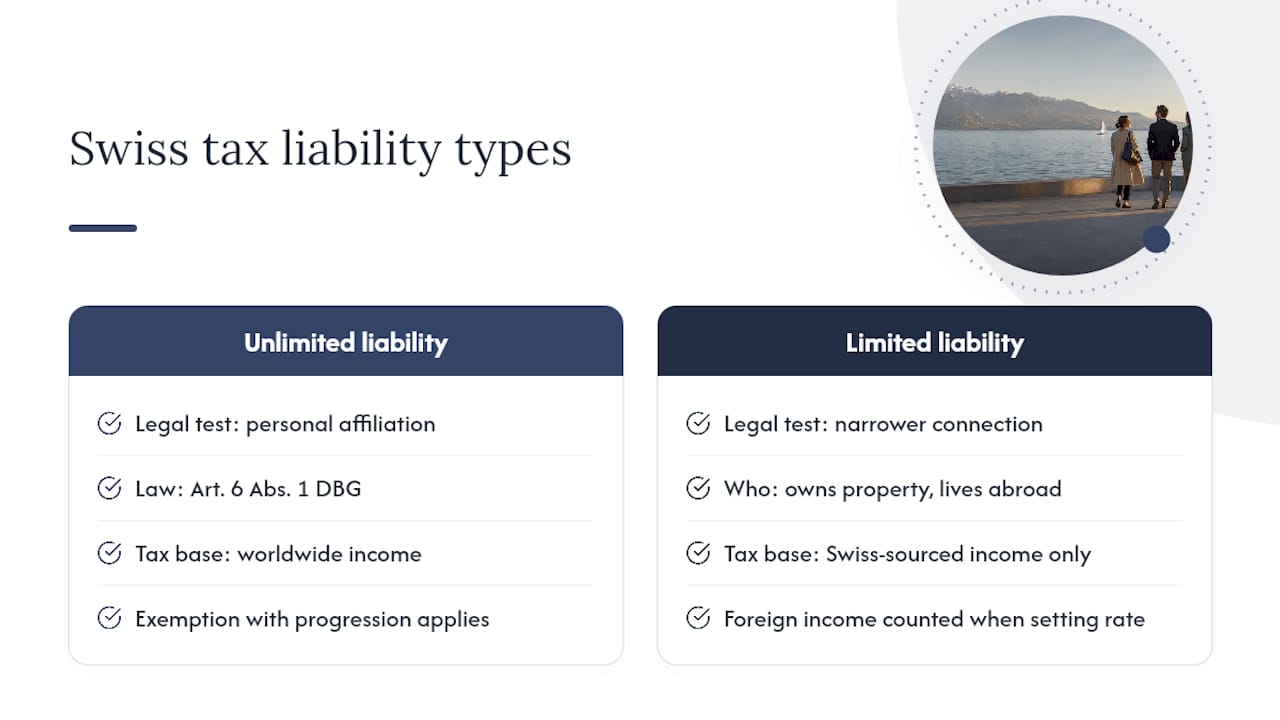
Limited liability applies to people with a narrower connection to Switzerland, typically someone who owns property here but lives and works elsewhere, or holds specific Swiss income sources without residing in the country. If you’ve relocated your life to Lausanne, that’s not you.
The practical twist most newcomers miss is exemption with progression. Foreign income and assets aren’t always taxed directly in Switzerland, but under Art. 7 Abs. 1, they still get counted when calculating the rate applied to your Swiss income. So a rental property in London or a portfolio held abroad won’t necessarily be taxed twice, but it can quietly push your Swiss tax rate higher.
This is where a lot of expats get caught out. They assume “not taxed” means “irrelevant,” when it actually means “invisible until it changes your bracket.” Understanding this distinction early lets you plan disclosures and timing properly instead of discovering the effect on your first tax bill.
Home buying rules for expats: the equity math
Switzerland doesn’t make buying property easy for anyone, expat or Swiss national, and the rules are stricter than most Northern European or North American buyers expect. You need at least 20% of the purchase price as equity, with a portion required to be hard cash. You cannot finance the entire deposit through pension assets.
It’s worth weighing carefully against strategies covered in guidance on financing a home in Switzerland.
Banks then run an affordability test that disregards your actual mortgage rate. They calculate whether you could service the loan at a theoretical interest rate plus maintenance costs, typically estimated as a percentage of the property value annually. If your income doesn’t clear that bar, even at today’s much lower real rates, the mortgage gets declined.
For expats, there’s an added wrinkle: some cantons and lenders apply extra scrutiny to buyers on L or B permits, questioning long-term residency stability. C permit holders and Swiss-married expats generally face fewer hurdles. If you’re planning to buy in or around Lausanne, sort out your permit trajectory before you start viewing properties, not after you’ve fallen for one.
Which filing regime fits your situation?
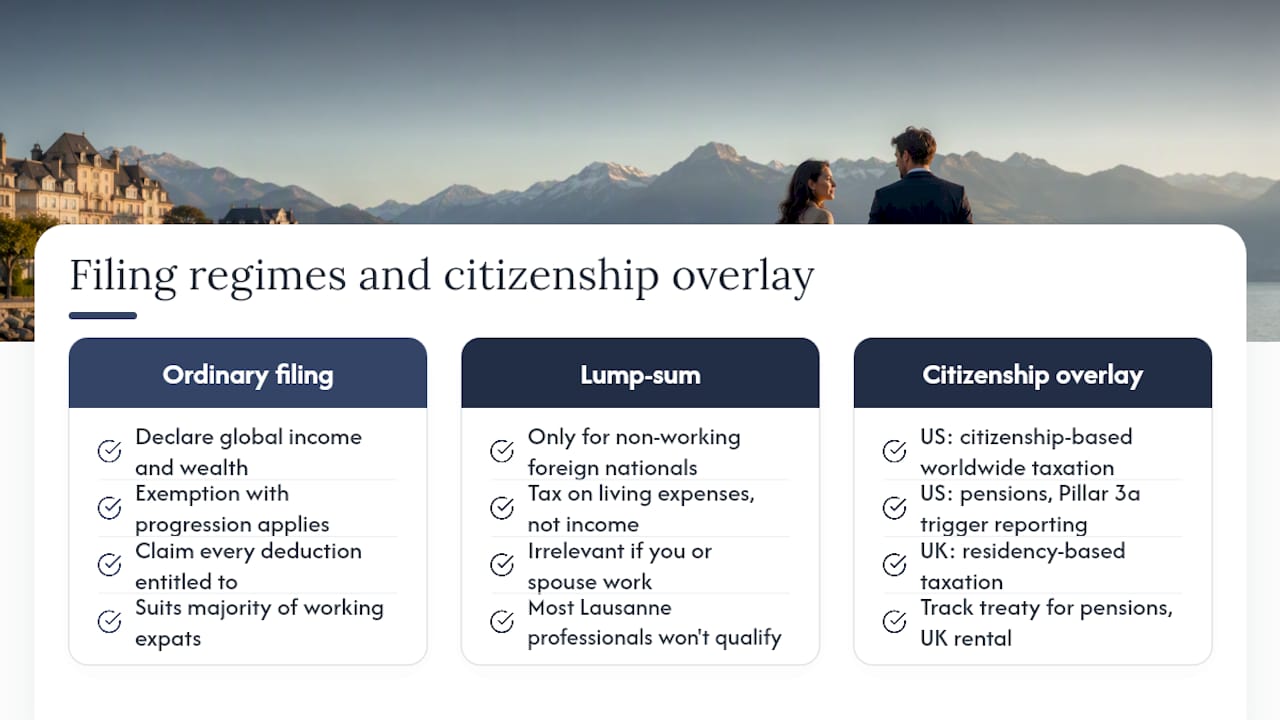
Most expats in Lausanne end up choosing between two very different paths: ordinary worldwide filing, or in rarer cases, a lump-sum taxation arrangement. Ordinary filing means declaring global income and wealth, applying exemption with progression, and claiming every deduction you’re entitled to. This suits the overwhelming majority of working expats, including anyone still taxed at source who wants to opt in voluntarily.
Lump-sum taxation is a different animal entirely. It’s available only to non-working foreign nationals who don’t take employment in Switzerland, and tax is calculated on living expenses rather than actual income. It’s largely irrelevant if you or your spouse work locally, so most Lausanne-based professionals won’t qualify, whatever they’ve read online.
Then there’s the citizenship overlay, and this is where things get genuinely complicated. American expats remain subject to US taxation on worldwide income regardless of where they live, thanks to citizenship-based taxation. That means Swiss pension contributions, Pillar 3a growth, and even some investment structures can trigger separate US reporting obligations that have nothing to do with Swiss law. British expats generally don’t face this, since the UK taxes based on residency, but they still need to track the UK-Switzerland double taxation treaty carefully, particularly around pensions and any UK-based rental income.
The lesson here: your passport matters almost as much as your permit. A filing decision that’s straightforward for a German or French national can be far messier for an American, so get country-specific advice before assuming Swiss rules are the only ones in play.
What should you document before seeing an adviser?
Walking into your first advisory meeting prepared saves time and money. Gather these before you book anything:
- Your permit type, issue date, and any renewal timeline.
- Pension records from every country you’ve worked in, not just your most recent employer.
- Property ownership details, both in Switzerland and abroad.
- Investment account statements, including any US brokerage accounts if applicable.
- Prior tax returns from your home country for the last two to three years.
Ask a prospective adviser direct questions: are they FINMA-regulated, how do they charge, do they specialise in expat or cross-border cases, and can they model canton comparisons rather than just generic advice. A good adviser should be able to show you, concretely, what moving your filing status or making a pension buy-in would save you, not just tell you it’s a good idea.
Watch for red flags too. Be wary of anyone pushing you into complex offshore structures without a clear Swiss tax rationale, anyone who can’t explain how they’re paid, or anyone who treats your permit status as an afterthought. Cross-border tax and pension planning genuinely benefit from specialist knowledge, and generalist advisers sometimes miss the details that matter most for people who’ve only recently arrived.
How do you find the right wealth manager in Lausanne?
Lausanne has no shortage of banks and boutique advisers, but not all of them are built for expat cases. Start by narrowing your search to firms that explicitly work with international clients and can demonstrate FINMA accreditation, which confirms they’re supervised under Swiss financial regulation rather than operating in a grey zone.
A useful filter is asking whether the adviser understands both sides of your situation: the Swiss tax and pension mechanics, and the cross-border reality of your home country’s rules. Someone who only knows Swiss law but not the US-Swiss tax treaty, for example, isn’t equipped for an American client’s full picture.
The evaluation process usually looks like this: an initial diagnostic conversation to understand your permit, income sources, and goals, followed by a proposal covering investment strategy, pension optimisation, and tax positioning. Tools like a structured financial planning review can help frame this conversation, especially if you’re comparing more than one adviser.
Don’t be afraid to ask for a written breakdown of fees before committing, and check whether the firm offers ongoing coaching or just a one-off portfolio setup. For many expats, especially women managing wealth independently for the first time, ongoing education and check-ins matter as much as the initial investment strategy. A firm that treats your first meeting as the start of a relationship, rather than a sales pitch, tends to be the better long-term fit.
What does wealth management cost in Lausanne?
Fee structures in Switzerland’s wealth management sector generally follow one of two models, and understanding both helps you compare offers properly. The first is a percentage of assets under management, typically charged annually and often tiered, meaning the rate drops slightly as your invested capital grows. The second is a flat or hourly advisory fee for specific services like tax planning, pension buy-in calculations, or a one-off financial review.
Some firms combine both: a management fee for ongoing investment oversight plus separate charges for coaching sessions or bespoke tax modelling. This is common for expats who need more than passive portfolio management, particularly in the first year or two when residency and pension decisions carry outsized weight.
Be cautious of unusually low headline fees that hide costs elsewhere, such as high-commission fund products bundled into your portfolio without clear disclosure. Ask directly what the all-in cost looks like, including underlying fund charges, not just the adviser’s own fee. A transparent adviser will walk you through this without hesitation.
For most expats settling in Lausanne, the sensible approach is to treat the first year’s advisory cost as an investment in getting the structural decisions right: permit-linked filing status, pension buy-ins, and canton positioning. Get those wrong, and the tax cost over a decade will dwarf what you paid an adviser to get them right the first time.
Cross-border tax traps that catch Americans and Brits
Swiss rules are only half the story if you’re not Swiss to begin with. Cross-border tax exposure depends heavily on your citizenship, not just your residency, and this is where generic Swiss tax guides fall short for internationals.
American expats face the heaviest overlay. The US taxes citizens on worldwide income no matter where they live, which means Swiss pension growth, Pillar 3a contributions, and even certain Swiss investment funds can create US reporting headaches under FATCA. Some Swiss banks have grown cautious about opening accounts for US citizens altogether, given the compliance burden it places on them. If you’re American and building a Swiss pension or investment plan, you need an adviser who understands both systems, not one who only speaks Swiss tax law.
British expats have it somewhat easier since the UK taxes based on residency rather than citizenship, but the UK-Switzerland double taxation treaty still needs careful handling, especially around UK pensions, ISAs (which Switzerland doesn’t recognise as tax-advantaged), and any rental income left behind in the UK. Moving to Lausanne doesn’t automatically sever UK tax residency either; that depends on meeting specific day-count and connection tests under the UK’s Statutory Residence Test.
The broader point: don’t assume Swiss compliance means you’re fully covered. Cross-border planning means checking both sides of the border, every year, not just at the point of arrival.
Insurance and asset protection for expats
Switzerland’s social insurance system covers a lot, but not everything, and expats often arrive with gaps they don’t realise exist until something goes wrong. Health insurance is compulsory within three months of arrival, but the basic policy doesn’t cover everything a family might need, particularly for those used to more comprehensive coverage back home.
Beyond health cover, think about disability and loss-of-income insurance, especially if you’re self-employed or your employer’s coverage is thinner than what you had before. Life insurance also plays a bigger role for expat families than it might have back home, partly because pension entitlements built up in Switzerland don’t always transfer cleanly if something happens to the primary earner.
Asset protection for expats also means thinking about where your assets sit legally. Property, investment accounts, and pension funds spread across two or three countries create real complexity if something happens to you unexpectedly, particularly around inheritance law, which differs sharply between Switzerland and countries like the UK or US. Reviewing succession structures alongside your investment plan, rather than as an afterthought, is worth doing early. Guidance on preserving wealth across generations covers this in more depth for families juggling multiple jurisdictions.
Investment choices and restrictions expats should know
Not every Swiss financial product is straightforward for expats, and a few restrictions catch people off guard. Pillar 3a accounts, for instance, are one of the most effective tax-deductible savings tools available, but contributions are capped annually and the money is largely locked until close to retirement, with limited early withdrawal exceptions like buying a home or leaving Switzerland permanently.
Outside pension wrappers, expats can generally invest in Swiss and international funds, ETFs, and direct securities without special permission, though your bank’s onboarding process may vary depending on your citizenship. American clients, again, often face restrictions here too, since many Swiss and European fund providers won’t sell to US persons because of the compliance burden under US securities law.
One area worth genuine caution: capital gains on private investments are generally tax-free in Switzerland for individuals, but that exemption doesn’t hold if the tax authority classifies you as a professional trader. High trading frequency, short holding periods, or heavy use of leverage can shift your gains into taxable territory without warning. If you’re managing your own portfolio actively, this is worth checking with an adviser rather than assuming the tax-free treatment automatically applies.
For most expats, a diversified portfolio held through a regulated Swiss platform, combined with a properly funded Pillar 3a, covers the bulk of sensible wealth building without running into these edge cases.
Why sequencing beats stock picking for expats
The biggest misconception I see among expats settling in Lausanne is that wealth planning starts with picking investments. It doesn’t. The three decisions that move the needle most are the order you handle your permit and filing status, how and when you make Pillar 2 buy-ins, and which canton you actually settle in.
As a FINMA-regulated adviser, Marmot Finance sees this pattern repeatedly: two clients with near-identical income can end up with a materially different tax bill purely because one filed correctly in year one and the other didn’t. This guide is a starting point, not a substitute for canton-specific modelling. A proper adviser can run the numbers for your exact situation and optimise your pension contributions accordingly.
Let Marmot Finance handle the moving parts
Reading about permit classes and canton spreads is one thing. Actually modelling your own numbers against Geneva versus Zug, or working out how much a Pillar 2 buy-in would save you this tax year, is another. Marmot Finance is the FINMA-accredited option built specifically for expats and families who want someone local to run those calculations rather than guessing from a blog post.
Marmot Finance combines personal advisory sessions with digital tools, including canton-rate modelling and a pension buy-in calculator, to build a plan around your permit, your pension gaps, and your cross-border obligations. The process usually starts with an initial diagnostic covering your residency status, existing pensions, and goals, followed by a clear timeline: registration and filing decisions first, then buy-ins and mortgage planning once the structural pieces are in place. Fees are based on assets under management plus advisory services where needed.
If you’d like a straightforward starting point, take the Money Makeover Quiz or book an initial review through Marmot Finance’s wealth management page to see where your plan stands today.
Frequently asked questions
Do I need to file a Swiss tax return if I’m taxed at source? Not always, but opting into ordinary filing can let you claim Pillar 3a contributions, professional expenses, and other deductions you’d otherwise lose. The decision is generally binding for several years, so model it before opting in.
How much can canton choice actually affect my wealth tax? It can be substantial. Comparisons between cantons like Geneva and Zug show the canton-choice effect often outweighs the tax-rate bump caused by foreign income under exemption with progression.
Can I use my pension to help buy a home in Lausanne? Yes, but only up to a point. You need 20% equity total, with at least 10% in hard cash. Pillar 2 funds can cover the remaining portion, though withdrawing early reduces your future pension and triggers separate tax treatment.
Does moving to Switzerland end my UK or US tax obligations? Not automatically. Americans remain taxed on worldwide income regardless of residency. Britons need to meet specific tests under the UK’s Statutory Residence Test before UK tax residency actually ends, even after relocating.
When should I make a Pillar 2 voluntary buy-in? Buy-ins work best once your income and pension gap are clear, often a year or two after arrival, and they’re most effective when spread across several years rather than made in one large lump sum.
Sources
For permit-based tax status, see the rules on foreigner taxation. For residency and worldwide liability under Art. 6 DBG, check the worldwide income guide. For cantonal variation, the official Swiss tax system overview and ESTV’s tax system report explain wealth tax mechanics in detail. For pension buy-ins, see guidance on pension fund purchases.
- Taxes in Switzerland for foreigners: rules, rates & filing tips
- Do Swiss residents pay tax on worldwide income? 2026 guide
- Mastering the Swiss financial maze: A guide to pensions, investing, and home ownership
Recommended
- Financial Planning for Expats in Switzerland | Marmot Finance
- Estate Planning Essentials in Switzerland for Affluent Families | Marmot Finance
- Wealth Management in Lausanne | Marmot Finance
- Cross-Border Financial Planning in Zürich for International Professionals | Marmot Finance


.webp)





.jpeg)




.png)

.svg)


