

The three moves that matter most: max out your Pillar 3a contributions every year without fail, split your savings across multiple 3a accounts so you can withdraw them in separate tax years, and get your occupational pension (LPP) certificate reviewed now to see whether a buyback makes financial sense. These three tactics, done in the right order and coordinated with your spouse if you have one, do more for your net retirement income than almost anything else available to residents planning ahead in Meilen.
TL;DR:
- Opening multiple Pillar 3a accounts and withdrawing from them in different years reduces the overall tax impact when accessing retirement savings.
- Reviewing your LPP certificate for gaps and considering buybacks can lead to significant tax savings and better retirement funding.
- Properly modeling staggered withdrawals and coordinating timing with your spouse can save thousands of francs in taxes, especially for larger sums.
- Planning housing and partial retirement options carefully can optimize pension outcomes and preserve liquidity for investments.
- Regularly updating your retirement plan every few years and aligning it with canton-specific tax rules maximizes long-term financial benefits.
Marmot Finance
marmot.finance
Plan Your Swiss Financial Future
Marmot Finance helps women and families in Switzerland build tailored investment strategies through personal consultations and digital tools.
What are smart retirement strategies in Meilen, practically speaking?
Forget generic advice about “saving more.” The real leverage in Swiss retirement planning sits in a handful of specific, repeatable actions. Here is the priority order that tends to produce the biggest results for the least effort.
- Maximise your Pillar 3a contribution every single year. Missed years cannot be backdated in most cases, so treat this like a bill you cannot skip.
- Open a second or third 3a account if you only have one. This sounds like paperwork, but it is the single most underused tax lever in Swiss retirement planning, because it lets you spread withdrawals across different tax years instead of taking one large, heavily taxed lump sum.
- Pull your latest LPP certificate out of the drawer and actually read it. Look for gaps between your insured salary and what you have accumulated. That gap is often where a buyback opportunity lives.
- Model your withdrawal timeline now, even if retirement is a decade away, with practical budgeting exercises like those in the No Spend Reset Challenge Workbook to help plan staged withdrawals and manage your retirement cashflow effectively. Staggering withdrawals across years, and ideally alternating years with a spouse, is one of the most reliable ways to reduce the progressive tax hit on lump-sum capital.
- Check your OASI/AHV contribution record for missing years, especially if you took time off work, studied abroad, or were self-employed for a stretch.
Beyond the big five, a few supporting habits round out the picture:
- Review your mortgage strategy alongside your pension plan rather than treating them as separate decisions.
- Consider partial retirement if your employer allows it, since reduced hours can smooth both income and pension contributions.
- Keep a running note of which canton you expect to retire in, because withdrawal tax rates differ meaningfully across Switzerland.
- Revisit your plan every two to three years, not just in the final stretch before retirement.
Pro Tip: Set a recurring calendar reminder for early December each year to check whether you have used your full Pillar 3a allowance. Missing even one year’s contribution because you forgot is one of the most common and avoidable losses in Swiss retirement planning.
How does Switzerland’s three-pillar system shape your choices?
Switzerland built its retirement system on three distinct pillars, and understanding what each one actually does is the difference between guessing and planning.
AHV/OASI (the first pillar) is the state pension, funded through mandatory payroll contributions. It provides a baseline income in retirement, but on its own it rarely covers more than basic living costs. Everyone working in Switzerland pays into it, and gaps in your contribution history (from time abroad or non-employment periods) can quietly shrink your future payout.
LPP, the occupational pension (second pillar), is where your employer and you both contribute a percentage of your salary, invested and grown over your working life. This is usually the largest pot of retirement money most people have, and it is also where buyback opportunities live, since you can voluntarily top up gaps in your LPP account and deduct that amount from taxable income.
Pillar 3a and 3b (the third pillar) are the voluntary, tax-advantaged savings you build yourself. Pillar 3a is capped and deductible; Pillar 3b is uncapped but offers fewer tax perks. For most people planning ahead, Pillar 3a is the sharpest tactical tool available, because it is the one pillar where you control the timing, the account structure, and (within limits) how the money is invested.
- AHV/OASI: baseline income, contribution record matters more than most people realise.
- LPP: largest pot for most earners, buyback potential, employer-linked.
- Pillar 3a/3b: voluntary, tax-deductible (3a), flexible timing, your decision entirely.
Canton also matters more than people expect. Withdrawal tax on lump-sum pension capital is calculated separately from income tax and varies significantly by canton of residence at the time of withdrawal, not by where you worked. Two people with identical pension pots can pay noticeably different tax bills purely based on where they are registered when they cash out.
What tax and withdrawal tactics save the most money?
This is where the real savings sit, and where a bit of planning pays for itself many times over.
For 2026, employees covered by a second pillar can contribute up to CHF 7,258 into Pillar 3a and deduct the full amount from taxable income. Self-employed people without a second pillar can contribute up to 20% of net income, capped at CHF 36,288, and there is now a retroactive buy-in allowance worth checking with a tax adviser if you have missed contribution years recently.
Why multiple 3a accounts matter: you can generally withdraw only one 3a account per calendar year without triggering the full progressive tax rate on the combined total. Holding everything in a single account means one large, expensive withdrawal. Splitting savings across three or four accounts, opened over several years, gives you the flexibility to spread withdrawals and meaningfully reduce the tax hit.
LPP buybacks work differently. You voluntarily pay into your occupational pension to close a gap between your insured salary and your actual savings, and that payment is fully deductible from taxable income in the year you make it. The catch: withdrawals within three years of a buyback cancel the tax benefit retroactively, so timing matters enormously. Buybacks tend to make the most sense for higher earners in their peak tax years, or for late starters who have real gaps to fill, but they require confidence that the pension fund itself is healthy and that you will not need that capital back out within the lock-up window.
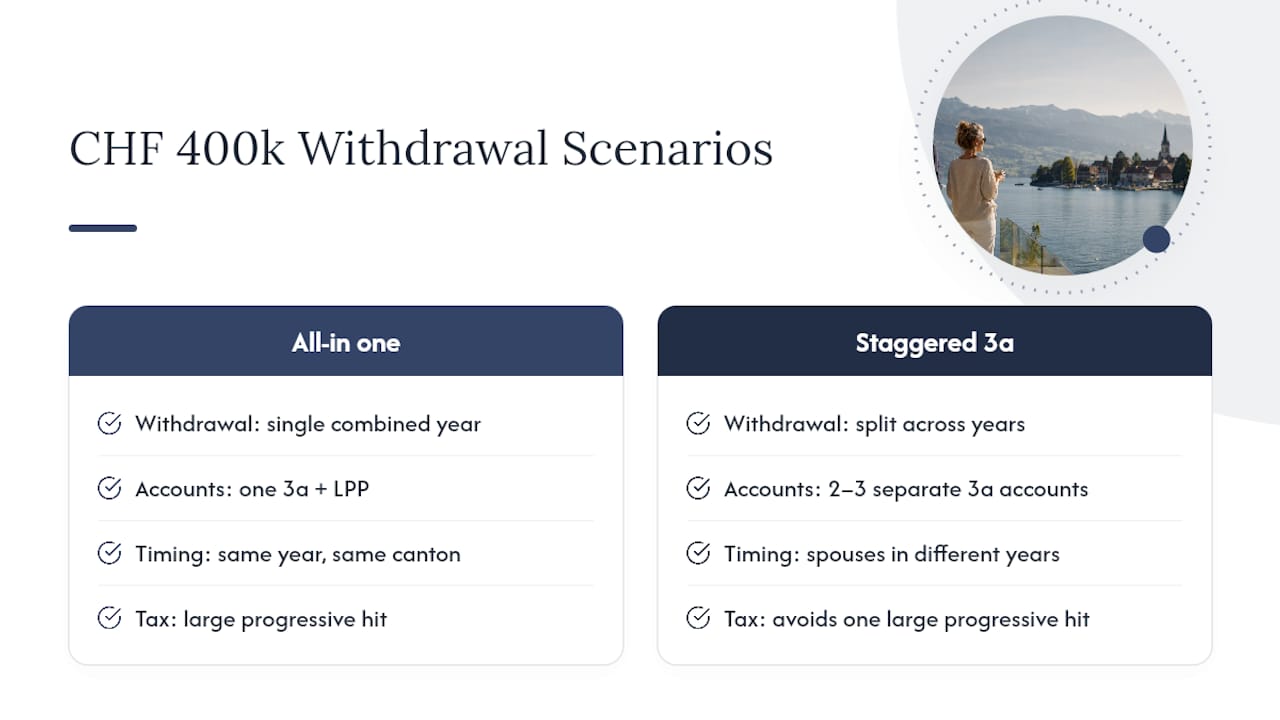
Here is a simplified worked scenario. A couple with combined 3a and LPP capital of roughly CHF 400,000 who withdraw it all in one year, in one canton, at the same time, will typically face a materially higher marginal tax rate than if they had split withdrawals: one spouse withdrawing in one year, the other the next, each spread across two or three separate 3a accounts. People who plan this properly often save somewhere in the range of CHF 6,000 to CHF 20,000, depending on canton and total withdrawal size, according to staggered withdrawal analysis. For larger sums, or if you are weighing a move to a lower-tax canton before withdrawal, talk to a tax specialist who knows your canton’s specific rates. A one-time relocation can genuinely change the tax bill, but only if it reflects a real change in your centre of life, not a paperwork exercise.
Lump sum, annuity, or a mix: what should you choose?
There is no universally correct answer here, but there is a clear way to think it through.
A lump sum gives you liquidity and control. You decide how to invest it, and whatever remains at your death typically passes to your heirs rather than disappearing. The risk sits entirely with you: markets fall, money runs out, or you simply live longer than your plan assumed.
An annuity gives you a guaranteed income for life, which removes the anxiety of managing a large sum yourself. The tradeoff is that annuity income is usually taxed as regular income each year, rather than benefiting from the lower one-time rate applied to lump-sum withdrawals, and most pension funds keep the remaining capital if you die early, leaving nothing for your heirs.
A mixed approach, taking part as a lump sum and leaving the rest as an annuity, is often the most sensible middle ground, particularly when combined with staggered 3a withdrawals in separate years.
- Liquidity and inheritance: lump sum wins, since capital passes to heirs.
- Income stability: annuity wins, since payments continue regardless of markets or longevity.
- Tax timing: lump sum benefits from one-off preferential rates; annuity income is taxed annually.
Pro Tip: Before choosing, write down three things: your realistic life expectancy given family health history, whether you have dependants who would need the capital, and how comfortable you genuinely are managing a large sum without a guaranteed income backstop. Bring that list to your adviser rather than starting from scratch in the meeting.
Do housing and partial retirement affect your pension outcome?
Yes, and often more than people expect. Paying off your mortgage aggressively feels responsible, but it can leave you with less liquidity for investments that might outperform the interest you are saving. There is no single right answer, but the trade-off deserves a real conversation rather than a default assumption that debt-free is always better.
Using Pillar 3a or LPP capital to buy a home is allowed under specific conditions, but withdrawing early has lasting tax and pension implications, and repaying it later has its own rules. Model this carefully before signing anything.
- Weigh mortgage repayment speed against the opportunity cost of tied-up liquidity.
- Understand the tax and repayment conditions before using pension capital for a home purchase.
- Consider phased or partial retirement, which can preserve pension accrual while easing you into lower income gradually.
Partial retirement, in particular, is underused. Reducing your hours rather than stopping outright often keeps you contributing to your pension longer, smooths your income curve, and delays the tax spike that comes with a sudden full withdrawal.
What should you do 10, 5, and 1 years before retiring?
- 10 years out: run a gap analysis on your AHV/OASI and LPP records, open a second or third Pillar 3a account if you only have one, and start rough modelling on whether a buyback makes sense for your income bracket.
- 5 years out: finalise your multi-account 3a contributions, sketch a concrete staggered withdrawal schedule, and complete any planned LPP buybacks while you still have time before the retirement date to clear the three-year lock-up.
- 1 year out: formally register your pension fund withdrawal choice (lump sum, annuity, or mix), coordinate timing with your spouse if applicable, confirm how your canton will tax the withdrawal, and gather every document your pension fund and tax office will ask for.
How does Marmot Finance support this kind of planning?
Marmot Finance is a FINMA-accredited wealth manager built specifically for women and families in Switzerland, and this kind of retirement modelling sits at the centre of what the team does day to day.
A typical engagement includes a pension-gap analysis using your actual AHV and LPP certificates, buyback modelling to test whether a top-up genuinely pays off after tax, a staggered withdrawal schedule tailored to your accounts and your spouse’s, and canton-specific tax modelling so you are not guessing at withdrawal rates.
- Accredited financial advice rather than generic online calculators.
- Financial quizzes and coaching to help clients get started.
- A substantial number of women have used tailored retirement planning processes.
This piece was written by Tom, drawing on published Swiss pension and tax guidance rather than firsthand case data.
Why most retirement advice in Switzerland misses the point
Most retirement content online tells you to “save more” or “start early,” which is true but useless if you are already 45 and have not opened a second 3a account. The advice that actually changes outcomes is structural: how many accounts you hold, which year you withdraw in, and whether your LPP certificate has a gap worth closing.
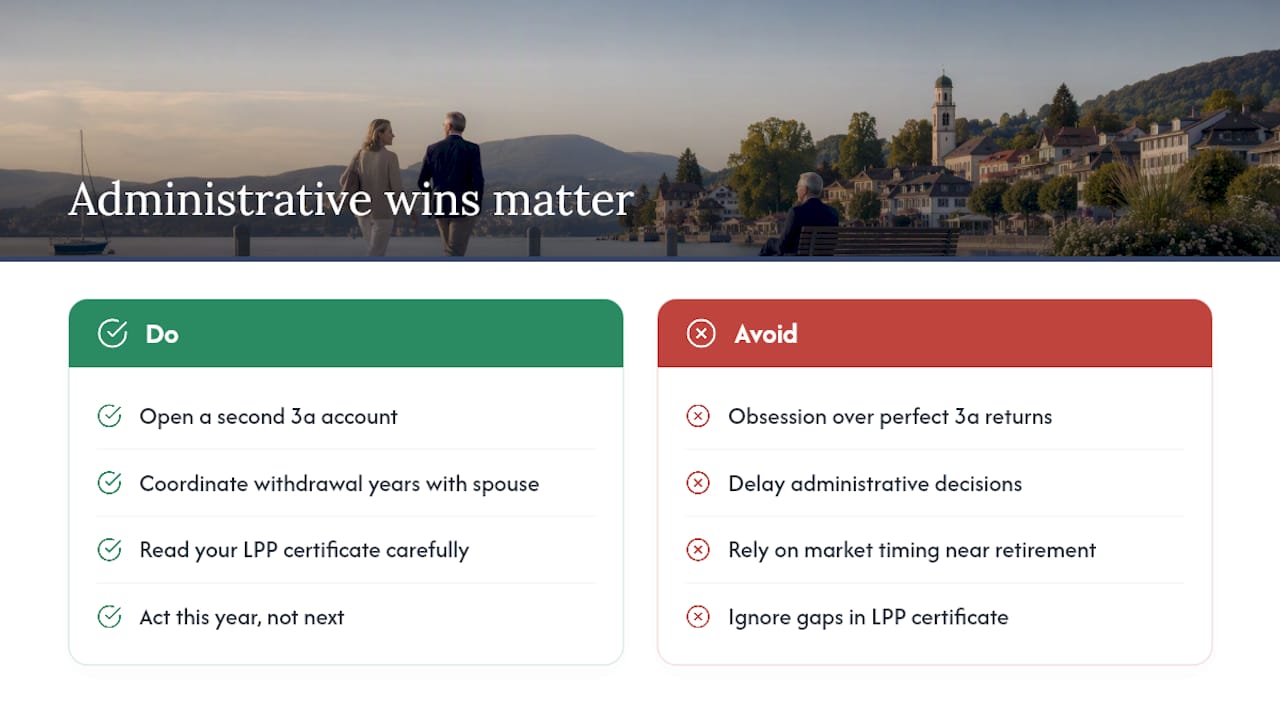
What gets overrated, in my view, is the obsession with picking the perfect investment return inside a 3a account. What gets underrated is account structure and withdrawal timing, which routinely save more in tax than an extra percentage point of investment performance ever will. Coordinating withdrawal years with a spouse is a genuinely under-discussed lever, and it costs nothing but a conversation and some paperwork.
If you take one thing from this article, it should be this: the biggest wins in Swiss retirement planning come from administrative decisions made years in advance, not clever market timing near the end. Open the second account. Read the LPP certificate properly. Do it this year, not next.
Ready to put a plan together?
Reading about staggered withdrawals is one thing. Actually modelling what your specific 3a accounts, LPP certificate, and canton mean for your tax bill is another, and that is exactly the gap Marmot Finance exists to close. Unlike a generic bank advisor juggling hundreds of unrelated cases, Marmot builds its process specifically around women and families who want a clear, personalised plan rather than a one-size-fits-all product pitch.
If you want a concrete starting point, the Money Makeover Quiz takes a few minutes and gives you a realistic sense of where your gaps sit before you speak to anyone. From there, a proper diagnostic can model your 3a staggering, test whether a buyback pays off, and map out canton-specific tax outcomes for your actual numbers. If you are near Basel, the wealth management team there can walk through this with you directly. Book that initial conversation while retirement is still years away, not months.
Sources
This article is general information, not a substitute for advice from a qualified financial advisor. Consult a qualified financial professional about your own circumstances before acting on anything here.
Recommended
- Tax Optimisation For Entrepreneurs in Meilen
- Inheritance tax in Switzerland
- Swiss Pension Optimisation in Lausanne


.webp)





.jpeg)




.png)

.svg)


