

Professional wealth management preserves capital and grows it over time by coordinating investment strategy, tax planning, succession and liquidity under one roof, rather than leaving each decision to chance. For families near Kilchberg with assets spread across borders or generations, a FINMA-regulated manager such as Marmot Finance replaces guesswork with a coordinated plan, oversight and, frankly, a lot less stress.
TL;DR:
- Wealth management costs between 0.8% and 1.2% of assets in Switzerland, with no hidden commissions and clear reporting to ensure value.
- Families with assets spread across countries or complex needs benefit most from personalized, coordinated strategies rather than simple retirement or savings accounts.
- Regulated managers must be FINMA registered, transparent about conflicts of interest, and utilize separate custodians for client assets to ensure security and compliance.
- Good wealth managers provide comprehensive reports, tailored investment policies, and ongoing communication to prevent oversight and support life goals like succession and business exit.
- Marmot Finance offers hybrid services with digital tools, transparent fees, and practical steps from discovery to account setup, ideal for families with complex or cross-border assets.
What are the core benefits of wealth management?
A wealth manager’s job is to stop your money decisions from working against each other. That sounds obvious, but it rarely happens by accident, especially once you own property in more than one country, run a business, or support family members with different financial needs.
Here’s what proper coordination actually looks like:
- Investment strategy: your portfolio gets built around your actual goals and risk tolerance, not a generic model. This means rebalancing when markets shift, rather than reacting emotionally after a bad month.
- Risk management: spreading exposure across asset classes, currencies and jurisdictions so one bad quarter in one market doesn’t sink your whole plan.
- Tax-aware structuring: your investment decisions get coordinated with specialist tax advisers so you’re not accidentally creating a tax headache while trying to grow your wealth. Goldblum & Partners notes that durable wealth structures depend on aligning residence, succession and governance rather than optimising one tax line in isolation.
- Succession planning: making sure wealth actually reaches the people you intend it for, in the shape you intend, with the legal groundwork done in advance.
- Cashflow and liquidity planning: having cash available for school fees, a business sale, or a sudden family need, without having to sell investments at the wrong moment.
- Consolidated reporting: one clear view of everything you own, instead of six statements from six institutions that never quite add up.
- Access to institutional opportunities: funds and structures that individual investors often can’t reach on their own.
Wealth management services at their best combine asset management, tax consultation and legal support into one coherent service, according to Moneyland’s independent explainer.
Pro Tip: Ask any prospective manager to show you a sample consolidated report before you sign anything. If they can’t produce one, they probably can’t deliver the coordination they’re promising.
How does wealth management support specific life goals?
Benefits only matter once they’re attached to something real. Here’s how the pieces above translate into outcomes families actually care about.
- Retirement: your manager models expected income against your pension arrangements, so you know years in advance whether you’re on track, not guessing at 60.
- Succession: rather than jumping straight to a costly single-family office, many families do better with governance structures, foundations or a hybrid outsourced approach. Outsourced family-office models can deliver similar coordination at a fraction of the internal overhead, according to RPCS’s guide on Swiss succession basics.
- Philanthropy: structured giving vehicles let you support causes efficiently while keeping the tax and legal side clean, rather than writing ad hoc cheques.
- Business exit: proceeds from a sale get protected and reinvested with a plan, instead of sitting exposed to market timing or a single concentrated position.
A family that sells a business in one calendar year, for instance, faces a genuinely different tax and liquidity puzzle than one drawing down a pension over two decades. Good wealth management treats each goal on its own terms rather than applying a single template.
What do wealth management fees actually cost, and what should you expect for that?
Fee structures generally fall into three camps: a percentage of assets under management, a flat annual fee, or a hybrid of the two. In Switzerland, independent managers typically charge 0.8% to 1.2% all in, while traditional private bank mandates often run 1.5% to 2.5%, according to Fortune Swiss’s overview of independent wealth management.
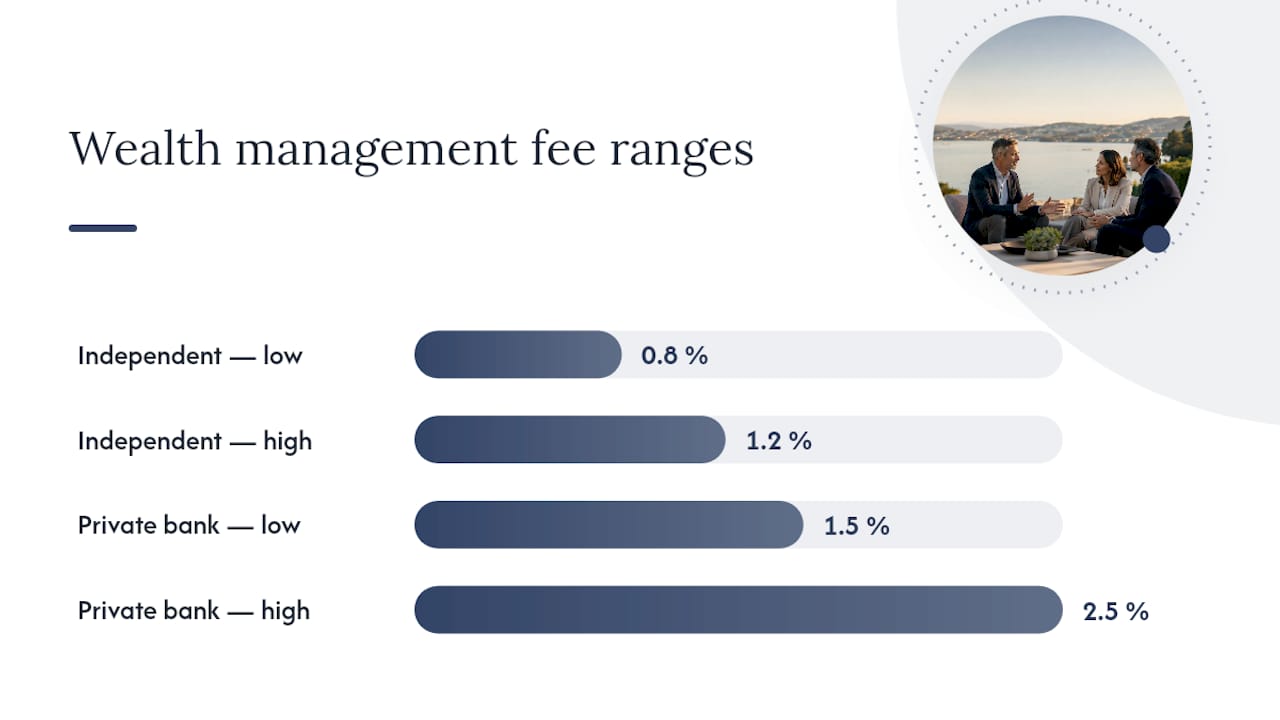
That gap isn’t trivial. On a CHF 2 million portfolio, the difference between a 1% and a 2% fee is roughly CHF 20,000 a year, compounding over decades into a meaningful share of total returns.
What separates good value from an expensive habit:
- No retrocessions (hidden commissions from product providers baked into your returns without your knowledge).
- Net-of-fees reporting, so you see your actual return, not a headline number before costs.
- A clear fee schedule you could explain to a friend in one sentence.
How do you choose the right wealth manager?
Start with the basics and work outward. Here’s a practical order to check things in:
- Confirm FINMA registration and which supervisory organisation oversees the firm. This is non-negotiable in Switzerland; regulated managers are your first line of protection.
- Ask about conflicts of interest directly. Do they accept retrocessions? Do they favour their own products?
- Clarify the service model. Discretionary means they make trades on your behalf within agreed limits; advisory means you approve each move. Ask which one you’re getting and why it suits you.
- Check custody arrangements. Your assets should sit with a separate, regulated custodian, never inside the manager’s own books.
- Request sample reporting and team CVs. A serious firm will show you both without hesitation.
Pro Tip: At your first meeting, simply ask: “Who holds my money, and how would I know if something went wrong?” The clarity of the answer tells you almost everything.
Why Marmot Finance fits families looking for these benefits
Marmot Finance is FINMA-accredited and built specifically around a hybrid model: personal consultations paired with digital tools that keep you informed between meetings, not just once a year. Over 350 women have used Marmot’s guidance to reshape their financial situation, working through tools like the Money Makeover Quiz and ongoing financial coaching alongside personalised investment mandates.
Custody sits separately from advice, and reporting is designed to show you the full picture in one place rather than scattered across accounts.
What happens once you decide to work with a wealth manager?
The process is more straightforward than most people expect:
- Discovery meeting: you talk through your goals, current holdings and concerns.
- Data gathering: statements, existing pension details, prior tax returns if relevant.
- Proposal and investment policy statement (IPS): a written plan showing strategy, risk level and fees.
- Account opening: typically two to four weeks, depending on how quickly documents come together.
Loop in your spouse, adult children or existing accountant early. Coordination works best when everyone’s reading from the same plan.
When is a wealth manager actually worth it?
In my view, the families who gain the most from professional wealth management aren’t necessarily the wealthiest on paper. They’re the ones juggling complexity: assets in more than one country, a business alongside a portfolio, or a blended family with succession questions that don’t have obvious answers. For a straightforward retirement account with one employer pension, a good financial planner might be enough.
What a wealth manager buys you, beyond returns, is continuity. Someone tracking the whole picture so nothing falls through the cracks when life gets busy. Marmot’s focus on education alongside management matters here too. Clients who understand their own plan make better decisions than those who simply hand over the keys.
— Tom
How Marmot Finance can help you put this into practice
Marmot Finance is built for exactly the situation this article has walked through: coordinating investments, tax, succession and liquidity under one FINMA-regulated roof, without the intimidation that often comes with traditional private banking. If you recognise your own situation in the benefits above, whether that’s a business exit on the horizon, cross-border assets, or simply wanting a clearer view of your finances, the next step is straightforward.
Take the Money Makeover Quiz to get a sense of where your finances stand today, or book a discovery call to talk through your specific goals with the team. You can also explore Marmot’s wealth management services directly, or see how the approach applies locally through wealth management in Kilchberg.
Sources
- Wealth management services explained | Moneyland
- Wealth management Switzerland — Independent Swiss wealth manager
This article is general information, not a substitute for advice from a qualified financial advisor. Consult a qualified financial professional about your own circumstances before acting on anything here.
Recommended
- Wealth Preservation in Kilchberg during Market Volatility
- Long-term wealth planning in Switzerland: securing generational wealth
- Preserving Generational Wealth: Private Wealth Management in Switzerland


.webp)





.jpeg)




.png)

.svg)


