

Banking access for expats differs because banks apply residency-based rules alongside layered international compliance obligations, including Anti-Money Laundering (AML) checks, Know Your Customer (KYC) requirements, and tax-reporting frameworks such as FATCA and the OECD Common Reporting Standard (CRS), all of which change how institutions accept and retain customers. The practical consequence is that an expat arriving in Switzerland faces a more demanding, slower, and sometimes more expensive path to a bank account than a Swiss resident would.
Three forces drive most of the friction:
- Regulatory reporting burden: Swiss banks must report foreign-resident account holders to their home tax authorities under CRS, and US citizens trigger additional FATCA obligations, making each international client administratively heavier.
- Customer due diligence costs: Verifying income, address, and source of funds for someone without a Swiss employment history or registered address takes more staff time and carries more compliance risk.
- Perceived jurisdiction risk: Clients from certain countries, or with financial ties to high-risk jurisdictions, require enhanced due diligence, which some banks prefer to avoid entirely.
Two things you can do right now: gather your core identity and address documents before you arrive, and open a digital account with a provider such as Neon on day one to cover immediate salary and payment needs while your formal registration is processed.
Why banking access differs for expats: the legal and commercial rules banks follow
Swiss banks do not restrict expat access arbitrarily. They operate under a framework that makes international clients genuinely more complex to serve, and understanding that framework is the first step to working with it rather than against it.
AML (Anti-Money Laundering) rules require banks to identify the source of a client’s funds and monitor transactions for suspicious patterns. In Switzerland, the Anti-Money Laundering Act (AMLA) sets the statutory baseline, and the Swiss Financial Market Supervisory Authority, FINMA, supervises compliance. Banks must demonstrate a “risk-based” approach to customer acceptance, which means they formally assess each client’s risk profile before opening an account and periodically thereafter.
KYC (Know Your Customer) is the practical process that flows from AML obligations: collecting, verifying, and retaining identity documents, proof of address, and evidence of income or wealth. For a Swiss resident with a local employer and a registered address, this is straightforward. For an expat who has just arrived, or who maintains financial ties in multiple countries, the same process involves more documents, more verification steps, and more judgement calls by the bank’s compliance team.
FATCA (the US Foreign Account Tax Compliance Act) requires Swiss banks to identify and report accounts held by US persons to the US Internal Revenue Service. The administrative burden this creates is significant enough that some Swiss banks have historically declined US clients or imposed additional requirements on them.
CRS (the OECD Common Reporting Standard) operates similarly for most other nationalities. Since 2018, Switzerland has participated in automatic exchange of account information with partner jurisdictions, meaning a German or French expat’s Swiss account balance and income are reported to their home tax authority. Banks must collect the documentation to make those reports accurately, adding to their onboarding workload.
“The era of anonymous or lightly documented Swiss accounts is over. Modern Swiss banking now emphasises radical transparency and detailed verification comparable to a tax audit.” This shift is structural, not cyclical, and it affects every non-resident client regardless of wealth level.
Beyond compliance, there is a straightforward commercial calculation. For many banks, the marginal cost of running a small international account, with its enhanced due diligence, periodic reviews, and reporting obligations, exceeds the revenue that account generates. That is why large retail banks increasingly favour residents or high-value private clients, and why fintech providers have found a genuine gap to fill.
Sanctions screening and Politically Exposed Person (PEP) checks add a further layer. Clients with connections to sanctioned countries, or who hold or have held prominent public positions, trigger mandatory enhanced due diligence regardless of their personal circumstances. Banks that lack the specialist capacity to manage those cases often decline them outright.
How residency and visa status change the accounts available to you
Not all Swiss bank accounts are created equal, and the category you can access depends heavily on your residency status.

A residence permit alone does not guarantee access to a standard retail account. Many traditional banks still require a locally registered address and, in practice, a Swiss work contract before they will open a full-service account. The Anmeldung, the formal registration with your local commune, is the document that unlocks most of the resident account pathway, which is why securing it quickly after arrival matters so much.
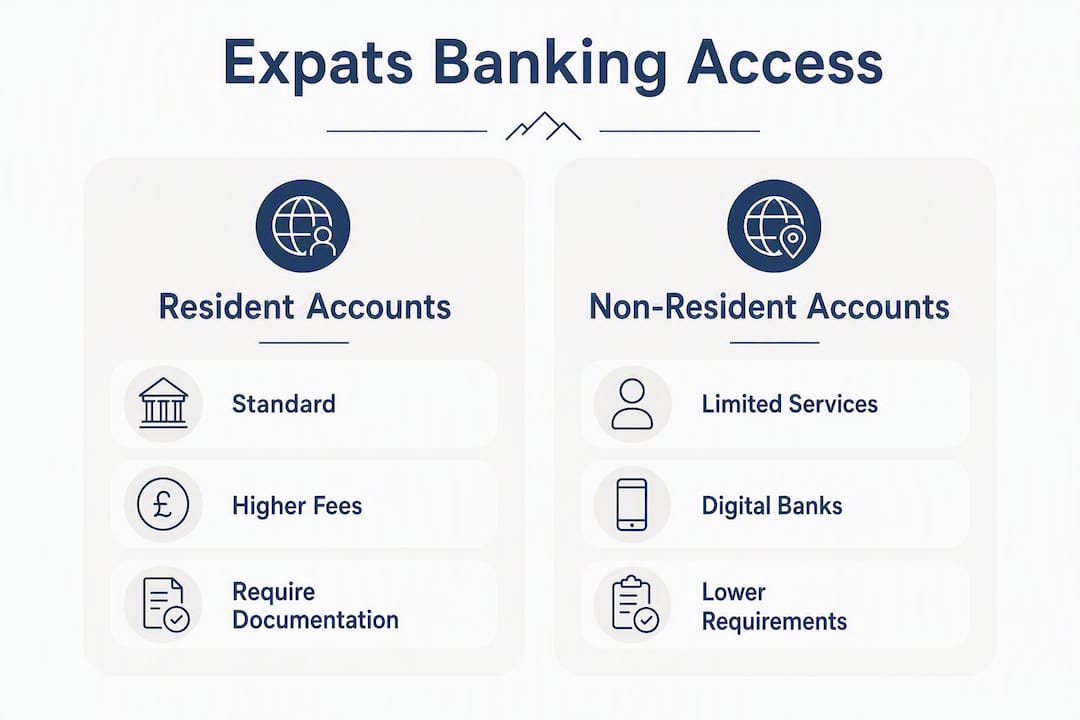
Digital banks fill the gap for new arrivals precisely because they do not require the full documentation stack from day one. Providers such as Neon issue a Swiss IBAN within hours, accepting a passport and a Swiss address, making them a practical bridge while formal registration is completed. The limitation is that some employers and landlords still prefer a traditional bank IBAN, so a digital account is a starting point rather than a permanent solution for everyone.
What documents Swiss banks typically require: a practical KYC checklist
Preparation is the single most effective way to reduce friction when opening a Swiss account. Banks vary in their exact requirements, but the following documents cover the vast majority of cases.
- Valid passport or national identity card — the primary identity document; a driving licence is not sufficient.
- Proof of Swiss address — either the Anmeldung confirmation from your commune or a signed lease agreement in your name.
- Residence permit — B permit (temporary residence), C permit (settlement), or L permit (short-term) where applicable; EU/EFTA citizens may use their registration certificate.
- Proof of income or employment — a recent employment contract, three months of payslips, or a letter from your employer on company letterhead.
- Recent tax residency certificate — particularly relevant for non-residents and those with income in multiple countries.
- Bank reference letter — required by some private banks and occasionally by traditional retail banks for non-resident applicants.
- Source of funds documentation — for larger deposits, banks require documentary evidence such as payslips, tax returns, inheritance documents, or sale contracts. Verbal explanations are not sufficient under AMLA obligations; the threshold at which this applies is typically transfers of CHF 10,000 or more.
The source-of-funds requirement catches many expats off guard, particularly those transferring savings from abroad to fund a property purchase or investment. Banks will refuse or freeze accounts if this documentation is missing, so assembling it before initiating a large transfer is worth the effort.
Pro Tip: If you are invited to an in-branch appointment, be straightforward about your income sources and financial history. Banks are not looking for perfection; they are looking for consistency and transparency. Avoid vague answers about where funds originated, and bring more documentation than you think you need. An over-documented client is far easier to onboard than an under-documented one.
Why banks restrict or close expat accounts, and what to do about it
Account restrictions and closures are more common among expat clients than most people expect, and they rarely happen without a preceding pattern of activity that triggered the bank’s compliance systems.

Unexplained large transfers are the most frequent trigger. A transfer of CHF 50,000 from an overseas account, without prior notice or supporting documentation, will almost certainly generate a compliance review. The remedy is straightforward: notify your bank in advance of any significant incoming transfer, and have your source-of-funds documents ready to submit immediately.
Extended dormancy raises flags because it suggests the account may have been opened for a purpose other than regular banking. If you hold a Swiss account but live abroad for extended periods, make at least periodic transactions and keep your contact details current with the bank.
Changes in residency without notification are a compliance failure from the bank’s perspective. If you leave Switzerland but retain your account, the bank’s reporting obligations change. Failing to inform them of your new address or tax residency can result in the account being flagged or closed. Always notify your bank in writing when your residency status changes.
Linked high-risk jurisdictions can affect clients who receive funds from, or send funds to, countries on FATCA lists or international sanctions registers. This does not necessarily mean the client has done anything wrong, but it does mean the bank must conduct enhanced due diligence, and some institutions will decline rather than invest the resource.
If your account is restricted, contact the bank’s compliance department directly and in writing, providing any documentation they request promptly. If you believe the restriction is unjustified, the Swiss Banking Ombudsman offers a free mediation service. Acting quickly matters: frozen accounts can affect payroll, rent payments, and investment activity within days.
What banking options are realistically available to expats in Switzerland
The Swiss banking market offers four distinct categories for expats, each with a different risk appetite, cost structure, and suitability profile.
UBS, as the dominant institution following the 2023 absorption of Credit Suisse, has become notably more selective about new non-resident retail accounts. PostFinance, as a state-affiliated institution, offers broader access for residents but has its own restrictions for non-residents. Post-2023, large retail banks are considerably more selective about new non-resident accounts, while private banks remain open to non-residents but at high asset minimums.
Wise deserves specific mention for expats who need to manage money across currencies. It is not a Swiss bank and does not provide a Swiss IBAN, but it offers multi-currency accounts with transparent fees and is widely used by digital nomads and internationally mobile professionals as a complement to a local account. Neon, by contrast, does provide a Swiss IBAN and is fully integrated with the Swiss payment system, making it the more practical day-one solution for those arriving in Switzerland.
For cross-border financial planning in Zürich and other Swiss cities, the combination of a fintech account for daily transactions and a private banking or wealth management relationship for longer-term assets is increasingly the structure that internationally mobile clients use.
How to improve your chances: a practical timeline and what it costs
The sequence in which you take steps matters as much as the steps themselves.
- Within the first two to four weeks: — Complete your Anmeldung at the local commune. This is the document that unlocks the resident account pathway at traditional banks.
On costs: non-resident-oriented services at traditional banks typically carry maintenance fees of CHF 30 to CHF 300 per month, with minimum opening deposits ranging from CHF 10,000 to CHF 50,000. Fintech accounts carry no such minimums and often have zero or minimal monthly fees, which is why they are the practical starting point for most new arrivals. For those considering financing a home in Switzerland, establishing a traditional banking relationship early strengthens the mortgage application considerably.
Maintaining the relationship once the account is open requires consistent, transparent behaviour: regular transactions, prompt responses to compliance requests, and proactive communication about any material change in your financial situation.
What the 2023 consolidation and 2026 AML reforms mean for expat banking access
The Swiss banking sector has undergone two significant structural shifts in recent years, both of which tighten the environment for non-resident clients.
The 2023 absorption of Credit Suisse by UBS reduced the number of major retail banking competitors in Switzerland and concentrated compliance decision-making in fewer institutions. The practical effect has been an increase in selectivity: with less competitive pressure, large banks have less incentive to accept complex or marginally profitable non-resident accounts.
The more significant change is the AML reform package taking effect on 1 October 2026. Switzerland’s new AML and transparency obligations expand due diligence requirements to legal entities and extend obligations to certain non-financial actors. The reform introduces the Transparency and Legal Entities Act (TLEA), which requires reporting of beneficial owners to a federal non-public register. Non-compliance can trigger administrative, civil, and criminal sanctions.
“The 2023 consolidation of major Swiss banks and the suite of AML reforms through 2026 signal durable structural tightening: banks are prioritising long-term, compliant relationships over volume-based client acquisition.” For expats, this means the documentation and transparency standards that felt demanding in 2024 will become the baseline, not the exception.
For expats and internationally mobile clients, the practical implication is clear: the bar for onboarding will rise further, and clients who cannot demonstrate clean, well-documented financial histories will find fewer institutions willing to serve them. Consulting FINMA’s published guidance and EY’s AML reform summary directly is advisable for anyone managing a complex cross-border financial structure.
Key takeaways
Banking access for expats in Switzerland differs primarily because international compliance obligations, AML/KYC requirements, and commercial cost calculations make non-resident clients structurally more demanding for banks to serve.
A perspective on what expats actually need from Swiss banking
The conversation about banking access for expats tends to focus on the obstacles, and the obstacles are real. But the more useful framing, in my view, is to ask what a well-prepared expat actually needs from the Swiss banking system, and whether the system, for all its friction, can deliver it.
The answer is yes, but only if you approach it with the same rigour the banks themselves apply. The clients who struggle most are those who arrive expecting Swiss banking to work the way their home country’s banking does: a quick online application, minimal documentation, and an account within 48 hours. That expectation is reasonable in many jurisdictions. In Switzerland, it is not.
What the Swiss system rewards is transparency and preparation. A client who arrives with certified documents, a clear account of their income and assets, and a realistic plan for their first three months will find the process manageable. The same client who arrives with vague answers about fund origins and an expectation that the bank will simply trust them will encounter resistance at every stage.
The 2026 AML reforms are not a threat to well-prepared expats. They are a formalisation of standards that diligent clients already meet. The real risk is for those who have been managing cross-border finances informally, relying on relationships or legacy arrangements that the new transparency requirements will expose.
For expats who are also thinking about longer-term wealth, the banking question and the investment question are connected. Where you hold your assets, in which currency, and through which structure, all interact with your tax residency and reporting obligations. Getting the banking right is the foundation; building a coherent financial plan for expats in Switzerland on top of it is where the real value lies.
How Marmot Finance supports expats with Swiss banking and wealth planning
Marmot Finance is a FINMA-accredited wealth manager dedicated to women, families, and internationally mobile professionals in Switzerland and Europe. For expats who need more than a bank account, the firm offers cross-border financial planning, account-opening guidance, and personalised wealth management in CHF, EUR, and USD, structured around each client’s residency status, tax obligations, and long-term goals.
Where a standard bank relationship ends, Marmot Finance begins: helping clients understand how their Swiss account structure interacts with pension planning, investment portfolios, and cross-border tax reporting. The wealth management service covers portfolio construction using ETF and fund-based strategies, thematic approaches including sustainable and gender-lens investing, and ongoing financial coaching for clients who want to build genuine financial clarity rather than simply hold assets.
To discuss your situation and identify the most practical, compliant route to Swiss banking and wealth management, book an initial consultation with the Marmot Finance team.
Useful sources and further reading
- FINMA — Swiss Financial Market Supervisory Authority: primary regulator for Swiss banking; publishes guidance on AML, KYC, and client acceptance standards.
- EY Switzerland: AML reform and new transparency obligations: detailed summary of the October 2026 AML reform package, including TLEA and beneficial-owner reporting requirements.
- The Local Switzerland: can a Swiss bank refuse a foreign client?: practical overview of bank refusal rights, source-of-funds rules, and expat experiences.
- Global Investments: Swiss banking for non-residents: covers account types, non-resident acceptance trends, and private banking thresholds.
- Moneyland: Swiss bank fees for non-residents: fee and minimum deposit comparisons for non-resident accounts at Swiss banks.
- LivingEase: best Swiss bank accounts for expats: practical guide to day-one banking options and the recommended documentation sequence for new arrivals.
- Marmot Finance: financial planning for expats in Switzerland: Marmot’s own guide to the regulatory and financial planning considerations for internationally mobile clients in Switzerland.
This article provides general information about Swiss banking and regulatory frameworks. It does not constitute financial, legal, or tax advice. Readers should verify current requirements directly with their bank, FINMA, or a qualified professional before making decisions.
Recommended
- Financial Planning for Expats in Switzerland | Marmot Finance
- Finanzplanung für Expats in der Schweiz | Marmot Finance
- Grenzüberschreitende Finanzplanung in Zürich für internationale Fachkräfte | Marmot Finance
- Cross-Border Financial Planning in Zürich for International Professionals | Marmot Finance

.webp)





.jpeg)




.png)

.svg)


