

Demands for ethical investing are growing, and women are driving the movement in Switzerland more visibly than anywhere else in the country’s financial history. Swiss sustainable assets reached CHF 1,940 billion in 2026, up 3% year-on-year, and the shift is not happening by accident. Women investors, motivated by a distinct combination of values, security preferences, and long-term thinking, are reshaping how Switzerland’s wealth management industry builds and markets its products. What follows covers the evidence behind that claim, how to read the labels you will encounter, the practical barriers that still exist, and the concrete steps you can take today.
What the data shows: women are driving ethical investing in Switzerland
The evidence base here is stronger than ever, and it draws on Swiss-specific research rather than imported assumptions.

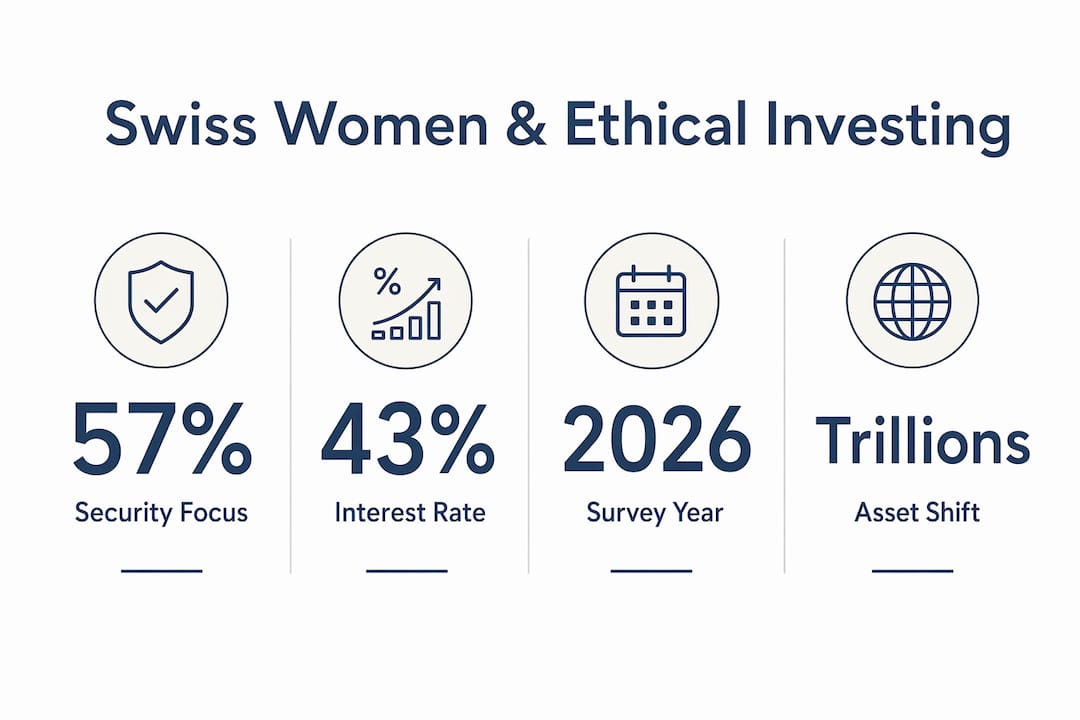
UBS Women’s Perspectives 2026 surveyed Swiss women on their financial priorities and found that security was their most important financial criterion for 57% of respondents, well ahead of returns. That preference for stability maps directly onto the characteristics of many ethical and ESG funds, which tend to screen out high-volatility sectors and favour companies with stronger governance.
Lombard Odier’s analysis goes further, warning that the Great Wealth Transfer will shift trillions in assets to beneficiaries who disproportionately prioritise values-based management. A significant share of that wealth will pass to women, creating structural, long-term demand for ethical strategies that is only beginning to show up in asset flows.
Around 43% of the Swiss population express interest in sustainable investing, according to SIX and Sustainable Finance Geneva, with sustainable investing now described as mainstream rather than niche. Yet the participation gap remains real. The same UBS study found that about 38% of Swiss women reported holding no securities, which means a large cohort of potential ethical investors has not yet entered the market.
The Gender Lens Initiative for Switzerland (GLIS), coordinated through Sustainable Finance Geneva, has also documented growing activity in gender lens investing, though practitioners note that data on actual fund flows remains fragmented. The direction of travel is clear; the measurement infrastructure is still catching up.
What ‘ethical’, ‘ESG’ and ‘impact’ investing mean, and how to read Swiss labels
These terms are used interchangeably in marketing materials, but they describe meaningfully different things. Getting the distinction right helps you ask better questions and avoid being misled by a label.
Ethical investing is the broadest category. It means applying personal or institutional values to investment decisions, typically by excluding sectors or companies that conflict with those values. Common exclusions include tobacco, weapons, gambling, and fossil fuel extraction. The approach is largely negative screening: you define what you will not own.
ESG investing uses a structured analytical framework. Environmental, Social, and Governance factors are scored and integrated into the investment process, either to screen out poor performers or to tilt a portfolio towards higher-scoring companies. ESG is a methodology, not a values statement. A fund can score highly on ESG metrics while still holding companies some investors would find objectionable, because the scoring reflects management quality and risk exposure rather than moral judgement.
Impact investing goes further. It targets measurable, positive outcomes alongside financial returns, typically in areas such as clean energy, affordable housing, or healthcare access. Impact funds are expected to report on what they actually achieved, not just what they excluded or scored.
Gender lens investing is a subset of impact investing that specifically targets gender equality outcomes, whether through investing in companies with strong female leadership, products that serve women, or supply chains that support women’s economic participation. The 2X criteria provide a practical measurement standard: they assess leadership representation, workforce composition, and access to finance for women. When evaluating a fund that claims a gender lens, asking whether it reports against 2X criteria is a more reliable test than reading the marketing copy.
In Switzerland, the Swiss Bankers Association (SBA) has made ESG preference surveys a standard part of the client advisory process. When you open or review an account at a Swiss retail bank, you will typically be asked whether you want sustainable options. The design of this process matters: opt-out defaults in advisory workflows can significantly raise allocation to labelled sustainable funds, which is why personal due diligence remains important regardless of what your bank recommends.
When reading a fund’s documentation, check for three things: the specific exclusion criteria and whether they match your values; the impact metrics and whether they are third-party verified; and the stewardship policy, meaning whether the fund manager actually votes its shares and engages with company management on ESG issues. A fund with a sustainability label but no stewardship activity is largely a marketing exercise.
Why women are more likely to choose ethical investments, and the barriers they still face
The alignment between women’s financial priorities and ethical investing is not coincidental. It reflects a consistent pattern across Swiss and European research.
Motivations that draw women towards ethical options:
- A preference for security and stability, which aligns with the lower-volatility profile of many ESG-screened funds
- Values alignment: the desire to ensure that money is not actively funding activities that conflict with personal or family principles
- Long-term investment horizons, which suit impact strategies that may take years to deliver measurable outcomes
- Intergenerational thinking, particularly the wish to pass on both wealth and values to children or grandchildren
- Social priorities, including climate, healthcare, and gender equality, which map directly onto the thematic funds now widely available in Switzerland
The Great Wealth Transfer adds a structural dimension to this. As large asset pools move between generations, women who inherit or co-manage family wealth tend to reorient portfolios towards values-based strategies. This is not a marginal trend; it is a structural shift in how Swiss and European wealth will be managed over the next two decades. Understanding the women’s wealth lifecycle helps explain why these preferences intensify at specific life stages.
Barriers that still limit participation:
- A knowledge gap around investment terminology, which makes ethical fund documentation harder to navigate than it needs to be
- Lower confidence in financial decision-making, which research consistently links to lower participation rates rather than lower capability
- Liquidity constraints, particularly for women who have taken career breaks or work part-time, which can make locking capital into investment accounts feel risky; see these smart money tips for single parents for practical budgeting advice
- Product jargon, including the ESG scoring systems themselves, which are not standardised across providers and can be genuinely confusing
- Opt-out default behaviours in bank advisory processes, which can result in sustainable allocations that were not actively chosen and are therefore not well understood
Pro Tip: If you are new to investing and want a low-friction starting point, Switzerland’s Pillar 3a pension savings account is worth considering first. Many providers now offer sustainably labelled Pillar 3a funds, the tax deduction makes the entry cost lower, and the structure limits how much you can contribute annually, which removes the pressure of deciding how much to commit.
How Swiss banks, asset managers and regulators are responding to rising demand
The Swiss financial industry has moved faster on sustainable products than most observers expected five years ago. Swiss sustainable assets reached CHF 1,940 billion in 2026, a figure that reflects both genuine product development and the reclassification of existing assets under new labelling frameworks. The distinction matters, because not all of that growth represents new money flowing into genuinely sustainable strategies.

The Swiss Bankers Association’s ESG preferences policy has changed the standard client journey at retail banks. Advisers are now expected to ask clients about sustainability preferences as part of the account-opening and annual review process. In practice, this means more clients are being allocated to labelled sustainable funds than would have chosen them independently, which raises both the headline numbers and the risk of misalignment between the label and the client’s actual values.
SSF’s 2026 commentary also highlights the growing materiality of nature-related risks, with asset owners increasingly setting net-zero and transition plans. Swiss asset managers are publishing transition roadmaps and net-zero commitments with greater frequency, but the quality of those commitments varies considerably. Investors should ask for timebound targets and third-party verification rather than accepting a net-zero pledge at face value.
The greenwashing risk is real and not limited to smaller providers. Several large European asset managers have faced regulatory scrutiny over fund labelling in recent years. In Switzerland, FINMA has signalled increasing attention to sustainable finance disclosures, which should improve standards over time, but the burden of due diligence still falls substantially on the investor.
Practical first steps for women in Switzerland who want to invest ethically
Getting started does not require a large sum or a sophisticated understanding of ESG scoring. It requires clarity on your values, a basic understanding of the account types available to you, and a few good questions to ask before committing capital.
Step-by-step starting checklist:
- Clarify your values and goals. Before looking at any product, write down the sectors or activities you want to exclude and the outcomes you want to support. This makes fund selection much more straightforward and helps you evaluate whether a provider’s offering actually matches your priorities.
- Review your Pillar 3a options. If you are employed in Switzerland and not yet using a Pillar 3a account, this is the most tax-efficient starting point. Several Swiss banks and fintech providers now offer sustainably labelled Pillar 3a funds. The annual contribution limit keeps the commitment manageable while you learn.
- Check your existing pension fund (Pillar 2). Many Swiss pension funds have adopted sustainability policies or offer sustainable investment options within their investment plans. Ask your employer’s HR department or the fund directly what its ESG policy covers.
- Choose tax-efficient account structures. Beyond Pillar 3a, a standard securities account (Depot) at a Swiss bank or broker is the next step. Consider whether you want a discretionary mandate (where a manager decides) or a self-directed account where you choose funds yourself.
- Vet funds with impact metrics. Look for funds that publish specific exclusion lists, report on carbon intensity or SDG alignment, and have a clear stewardship policy. Ask whether the fund manager votes its shares on ESG resolutions.
- Start with a small allocation and monitor both financial and impact reporting. You do not need to restructure an entire portfolio at once. A tailored portfolio strategy can begin with a single sustainably labelled fund and expand as your confidence and knowledge grow.
- Review annually. Sustainable fund labels and underlying holdings change. An annual review of both the financial performance and the impact reporting keeps your portfolio aligned with your original intentions.
Questions to ask an adviser or bank representative:
- How does this fund measure and report its impact? Are those metrics third-party verified?
- What is excluded from this portfolio, and does the exclusion list match my stated values?
- Does the fund manager vote its shares on ESG resolutions? Can I see the voting record?
- What are the total ongoing charges, and how do they compare to a conventional equivalent?
- Does this fund have a net-zero or transition target? Is it timebound and independently verified?
On fees: sustainably labelled funds in Switzerland typically carry ongoing charges that are broadly comparable to actively managed conventional funds, though there is meaningful variation. The performance question is more nuanced. Research published by Reuters found that positive ESG performance tends to improve returns globally, though results vary by sector, time period, and how ESG is defined. The evidence does not support the assumption that ethical investing requires a financial sacrifice, but it also does not guarantee outperformance.
Pro Tip: Test a strategy with a small allocation first, perhaps 10–15% of your investable assets, and track both the financial return and the impact report over 12 months. This gives you real data on whether the fund delivers what it promises before you commit more capital. For practical guidance on financial independence steps, Marmot Finance’s resources are a useful complement to this process.
How Marmot Finance works with women who want ethical investing
Marmot Finance is a FINMA-accredited wealth manager built specifically for women and families in Switzerland. That accreditation matters in practical terms: it means Marmot operates under Swiss regulatory oversight, with the client protection obligations that entails, and it is not a marketing claim.
The firm’s approach combines personal consultations with digital tools, which suits the profile of many women investors who want to understand what they own and why, rather than simply delegating to a manager they rarely hear from. Services relevant to ethical investing include expert wealth management with values-aligned portfolio construction, Pillar 3a and pension planning, financial coaching, and the Money Makeover Quiz, which helps clients clarify their financial position and priorities before making investment decisions. Over 350 women have worked with Marmot Finance to restructure their financial situations, and the firm manages accounts in CHF, EUR, and USD for Swiss and European clients.
For women who want to begin the process of aligning their investments with their values, the logical first step is a conversation with Marmot’s expert wealth management team, where the starting point is always your goals and values rather than a product catalogue.
This article provides general information about ethical investing in Switzerland and does not constitute personalised financial or investment advice. Please consult a qualified financial adviser or verify current regulations with the relevant Swiss authorities for your specific situation.
Key takeaways
Women are the primary force behind the growing demand for ethical investing in Switzerland, and the structural drivers, security preferences, intergenerational wealth transfer, and values alignment, mean that demand will continue to grow.
Why this movement deserves more than a trend label
The framing of women as “ethical investors” can inadvertently flatten something more substantive. What the Swiss data actually shows is that women tend to approach capital with a longer time horizon, a clearer sense of what they want money to do in the world, and a lower tolerance for opacity in how their assets are managed. Those are not soft preferences. They are the characteristics of a genuinely disciplined investor.
The industry has been slow to recognise this. For years, sustainable and ethical products were positioned as a niche for idealists willing to accept lower returns. That framing was always questionable, and the evidence has largely moved against it. What is more interesting is that women were right about the direction of travel before the data caught up. The security-first orientation that the UBS 2026 study documents is not risk aversion in the pejorative sense; it is a preference for resilience, which is exactly what well-constructed ESG strategies are designed to provide.
The gap between the 43% of Swiss people who express interest in sustainable investing and the much smaller share who have actually built a values-aligned portfolio is not primarily a product problem. It is an advice and confidence problem. Closing it requires advisers who take women’s financial priorities seriously as investment criteria, not as lifestyle preferences to be accommodated after the real financial decisions have been made. That is the gap Marmot Finance was built to address.
Marmot Finance: expert wealth management for women in Switzerland
If you are a woman, a family, or an international client with Swiss pension or tax planning questions, and you want to build a portfolio that reflects both your financial goals and your values, Marmot Finance offers a structured, FINMA-accredited route to doing that well. The firm works with clients across Switzerland and Europe, managing CHF, EUR, and USD accounts with a focus on long-term financial security rather than short-term performance chasing.
The Expert Wealth Management service is the right starting point: a conversation about where you are, what you want your money to do, and how to build a portfolio that holds up over time. No jargon, no pressure, and no assumption that you already know the answers.
Useful sources for further reading
These are the primary sources behind the claims in this article, and the most useful starting points if you want to verify figures or go deeper into any of the topics covered.
UBS Women’s Perspectives 2026 — The most detailed Swiss-specific survey of women’s financial priorities and investment behaviour, conducted by gfs.bern for UBS. Essential reading for understanding the security-first orientation documented here.
Swiss Sustainable Finance: Schweizer Marktstudie Nachhaltige Anlagen 2026 — The authoritative annual market study on sustainable assets in Switzerland, covering total AuM, growth trends, and emerging themes such as nature-related risks and net-zero transition plans.
SIX: Sustainable Investing Trends — SIX and Sustainable Finance Geneva’s overview of sustainable investing adoption in Switzerland, including the 43% interest figure and commentary on the SBA’s ESG preferences policy.
Lombard Odier: Do women investors really think differently? — A substantive commentary on women’s investment preferences and the structural implications of the Great Wealth Transfer for values-based asset management.
Gender Lens Initiative for Switzerland (Sustainable Finance Geneva) — GLIS resources on gender lens investing in Switzerland, including the 2X criteria framework and annual activity reports. Useful for anyone evaluating gender-focused fund options.
Reuters: ESG performance and returns research (2022) — A summary of global research on the relationship between ESG performance and investment returns, providing useful context for the performance expectations section.
Recommended
- Best Asset Classes for Women Investors in Switzerland | Marmot Finance
- Gender Gap Wealth Management: A Guide for Swiss Women | Marmot Finance
- Women Investment Advice Explained: Your Swiss Guide | Marmot Finance
- Women Investment Portfolio Guide for Swiss Investors | Marmot Finance

.webp)





.jpeg)




.png)

.svg)


