

The essential plan is simple to state and harder to execute: coordinate your pension pillars, use your Pillar 3a allowance properly, keep enough liquid cash to sleep at night, and check your estate paperwork once a year. Marmot Finance, a FINMA-accredited manager for women and families, suggests two moves today: confirm your current Pillar 3a ceiling and set aside three to six months of expenses. Pull out your last two pension statements before you start.
TL;DR:
- Entrepreneurs should confirm their Pillar 3a contribution ceiling annually and set aside three to six months of living expenses in accessible savings.
- Incorporation status dramatically impacts pension options, with incorporated founders facing tighter Pillar 3a limits and obligatory Pillar 2 contributions.
- Diversify investments across accounts using low-cost ETFs and rebalance at least once or twice a year, considering income stability and risk appetite.
- Maintaining clear estate documents, upgrading insurance coverage, and separating personal and business finances are crucial for long-term protection.
- Regularly review wealth and pension plans, especially after major life events or income changes, to ensure alignment with retirement goals and legal requirements.
How can entrepreneurs plan their wealth in Zug by starting with the right assessment?
Before touching a spreadsheet or calling an adviser, work out what you’re actually dealing with. The legal form of your business changes everything about your pension obligations. Run a sole proprietorship or partnership and you’re outside mandatory Pillar 2 (occupational pension) coverage, which gives you more room to use Pillar 3a generously. Incorporate as an AG or GmbH and pay yourself a salary, and you typically become a mandatory Pillar 2 contributor, which shrinks your Pillar 3a tax-deductible space considerably, according to RSM Switzerland.
Before your first proper planning conversation, gather:
- Net income figures from the last two to three years, not just this year’s guess.
- Any existing Pillar 2 statements, including vested benefits accounts from previous employment.
- Current 3a and 3b holdings, with provider names and values.
If your income swings wildly year to year, flexible 3a contributions usually beat locking into a pension fund early. If income has stabilised and you want death and disability cover, joining an occupational scheme starts to make more sense, a distinction Switzerland’s SME portal flags as central to early retirement decisions.
What Pillar 1, 2 and 3 options actually mean for your pension
Pillar 1 is Switzerland’s state pension (OASI), and everyone pays into it regardless of employment status. Pillar 2 is the occupational scheme, mandatory for employees but optional for the genuinely self-employed. Pillar 3 is your private layer, split into 3a (tax-privileged) and 3b (flexible, less favourable tax treatment).
The Pillar 3a numbers matter more than most entrepreneurs realise:
- If you’re not affiliated with a Pillar 2 scheme, you can contribute up to 20% of net income, capped at CHF 36,288 per year.
- If you are affiliated with Pillar 2, the 3a ceiling is reduced accordingly.
- Buy-backs into an occupational pension fund can offset years of low contributions, but only work well when modelled against your likely future salary path.
Statistic callout: An unincorporated entrepreneur with a certain net income could shelter a substantial amount through 3a alone, significantly more than an incorporated founder drawing a salary through the same channel.
Incorporation changes this calculation the moment you start paying yourself a salary; you shift from the generous non-affiliated ceiling to the tighter one, and Pillar 2 becomes compulsory. Review this setup annually, and revisit it immediately after incorporating, hiring your first employee, or a significant income jump. Comparis notes that the 2nd-versus-3rd-pillar decision hinges largely on income consistency, not ambition.
How should you build an investment plan around your pension?
Your business is already a concentrated bet on one asset: itself. That should shape how you invest everything else. If your company income is volatile, lean toward a higher allocation of bonds and cash-like holdings in your personal portfolio to balance that risk. If your revenue is steady and diversified across clients, you can usually afford more equity exposure elsewhere.
Think of your total wealth as one pool split across three containers: your 3a account, a taxable brokerage account, and any vested benefits from past employment. Each has different tax treatment and liquidity rules, but they should still add up to one coherent asset allocation, not three separate, uncoordinated portfolios.
Practical steps that work for most entrepreneurial situations:
- Use low-cost, broadly diversified ETFs for the core of your taxable and 3a holdings rather than picking individual stocks.
- Rebalance once or twice a year, not every time markets move.
- Keep vested benefits accounts invested rather than sitting in cash, since they often have decades to grow.
Pro Tip: Check the total expense ratio on every 3a fund before you commit. A difference of even 0.5% a year compounds into tens of thousands of francs lost by retirement.
Mirabaud’s research on Swiss occupational pensions confirms vested benefits and 3a products remain the two most common levers wealth managers use to optimise entrepreneurial retirement outcomes, as detailed in Retirement Income Planning Best Practices for Owners.
Liquidity and protection: what needs cash and what needs insurance
Most entrepreneurs need three to six months of personal living expenses in an accessible account, separate from business reserves. If your income is genuinely seasonal or project-based, lean toward six to nine months instead.
Keeping business and personal money in clearly separate accounts isn’t just tidiness. It preserves your pension contribution room and makes tax reporting far simpler, a point Comparis raises directly when discussing self-employed pension planning. Decide your salary or drawing method early, and keep it consistent.
Priority insurance for entrepreneurs usually includes:
- Disability income protection, since Pillar 1 and 2 payouts alone rarely replace a founder’s income.
- Life insurance if you have dependants or business partners relying on you.
- Health insurance with adequate daily allowance cover if you’re self-employed without an employer scheme.
Estate and succession steps entrepreneurs should take now
A clear ownership record and an up-to-date will protect both your family and your business from unnecessary friction. Start with the basics most founders postpone indefinitely.
- Draft or update your will, naming clear beneficiaries for vested benefits and 3a accounts specifically, not just general estate terms.
- Set up powers of attorney in case of incapacity, covering both personal and business decisions.
- Keep a written, current record of company ownership shares, especially if co-founders or family members hold stakes.
Private wealth planning and business succession are rarely separate problems for entrepreneurs; they’re one problem viewed from two angles. Cross-border situations, dual nationality, foreign assets, or international family members, add real complexity, and RSM Switzerland recommends specialist review precisely because foreign pension schemes may not be recognised under Swiss rules.
Your 6 to 12 month action checklist
Turning all of this into progress means sequencing it properly rather than trying to fix everything in one weekend.
- Months 1 to 2: Gather documents and run a pension gap check comparing your Pillar 1, 2 and 3 position against your target retirement income.
- Month 3: Set your emergency buffer and separate business from personal accounts if you haven’t already.
- Months 3 to 4: Decide whether flexible 3a or joining an occupational pension fits your income pattern better this year.
- Months 5 to 6: Implement your investment allocation across accounts and set a fixed review date, at minimum every five years or after major life events, as Switzerland’s SME portal recommends.
Seek tailored advice sooner if you’re incorporating, hiring your first employee, relocating across borders, or preparing to sell the business. Advisory fees for a proper pension and investment review typically take a few weeks to complete once documents are ready; budget for this as an annual cost, not a one-off.
Tax optimisation beyond pension contributions
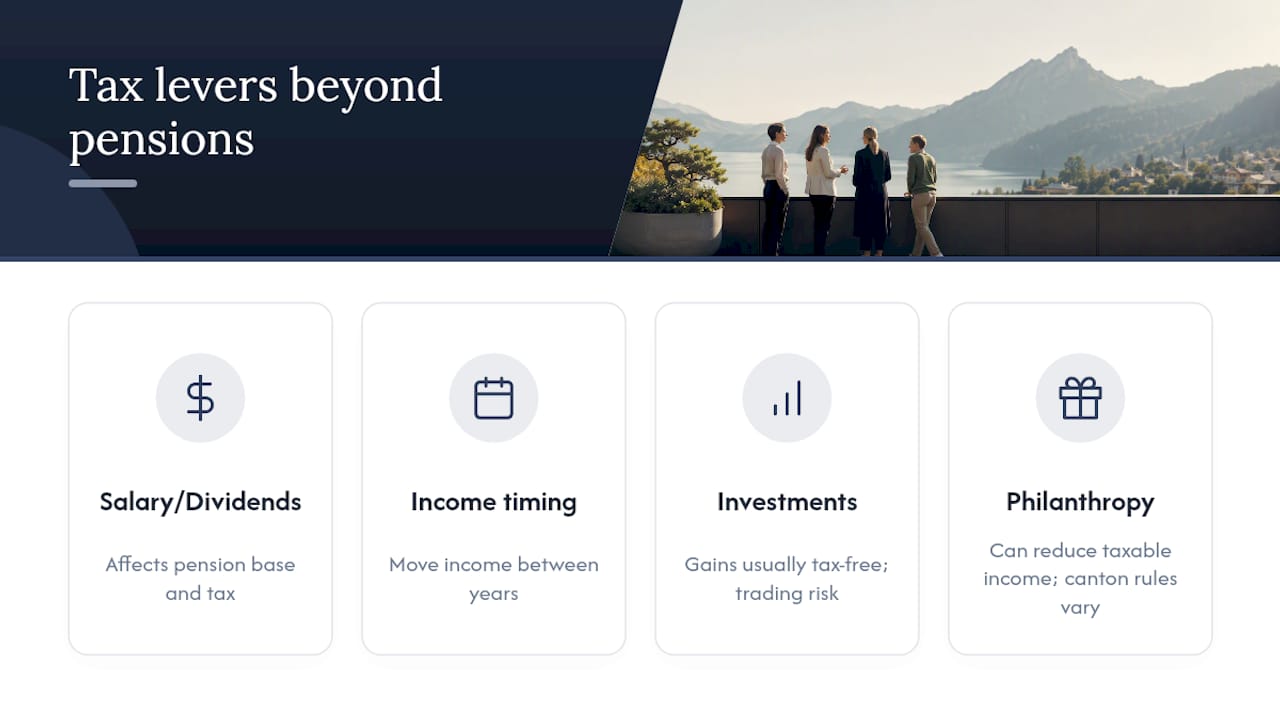
Pension contributions are the most obvious lever, but they’re not the only one. Timing income recognition, structuring dividends versus salary if you’re incorporated, and using tax-efficient investment wrappers all matter over a multi-year horizon.
If you’re incorporated, the split between salary and dividends affects both your personal tax bill and your Pillar 2 contribution base, so the two decisions can’t be made independently. A higher salary means more pension contributions but also more social security deductions; a higher dividend share reduces pension room but can lower overall tax drag depending on your canton.
Holding investments in tax-efficient structures matters too. Long-term capital gains on privately held securities are generally tax-free for individuals in Switzerland, which makes taxable brokerage accounts more attractive for entrepreneurs than in many other countries, provided you’re not classified as a professional trader. That classification risk is worth understanding before you trade frequently in a personal account.
Charitable giving and structured philanthropy, if relevant to your family’s values, can also reduce taxable income while supporting causes you care about, though the rules vary by canton and deserve their own conversation with an adviser. Marmot Finance’s guide on tax-efficient wealth structuring walks through how these pieces fit together for individuals rather than companies.
Risk management and insurance for entrepreneurial wealth
Running a business concentrates risk in ways employees rarely face. Your income, your net worth, and often your identity are tied to one venture, so personal wealth protection has to work harder.
Disability cover deserves particular attention. If an entrepreneur becomes unable to work, Pillar 1 and 2 benefits alone rarely replace lost income, especially for those outside mandatory occupational schemes. Supplementary disability insurance closes that gap, and it should be reviewed whenever income rises meaningfully.
Key-person risk matters too, particularly for family businesses. If you’re central to daily operations, consider what happens to revenue, and to your family’s finances, if you’re suddenly unavailable for months. Business interruption or key-person insurance can bridge that gap, though it’s often underused among smaller founder-led firms.
Diversifying personal assets away from the business itself is a form of risk management in its own right. Entrepreneurs who hold most of their net worth in company equity face a double loss if the business struggles: income disappears and asset value falls simultaneously. Building a separate, liquid investment portfolio outside the business is one of the clearest ways to reduce that correlation.

Legal considerations for entrepreneurs’ personal wealth
Personal and business legal structures interact more than most founders expect. How you’re registered, sole proprietor, partnership, AG, or GmbH, doesn’t just affect taxation; it determines your legal liability exposure, which in turn affects how much personal wealth needs separate protection.
Marital property regimes matter here too. Switzerland’s default matrimonial regime affects how business assets are treated in divorce or death, and founders who built a company before marriage sometimes assume protections that don’t actually exist under the standard regime. A marital agreement can clarify this, particularly where one spouse holds shares and the other doesn’t.
Cross-border legal exposure is another area entrepreneurs underestimate. If you hold assets, citizenship, or family members in more than one country, succession law and tax residency rules can conflict, and RSM Switzerland points out that pension recognition across borders is a common source of unexpected liability. This is precisely the kind of situation where a generalist adviser isn’t enough, and where specialist legal and pension advice pays for itself.
A step-by-step roadmap for entrepreneurial wealth planning
Pulling every stage together into one sequence helps make an abstract plan concrete.
Stage one, foundation (months 1 to 3): Assess legal structure, gather pension statements, and establish your emergency buffer.
Stage two, pension decisions (months 3 to 6): Choose your 3a versus Pillar 2 strategy, and if incorporated, model the salary-versus-dividend split against pension contribution room.
Stage three, investment build-out (months 6 to 9): Implement a coordinated asset allocation across 3a, taxable, and vested benefits accounts, with cost-conscious ETF selection.
Stage four, protection and estate (months 9 to 12): Finalise insurance priorities, update your will, and document business ownership clearly for heirs or co-founders.
Stage five, ongoing review (annually or at trigger events): Revisit the entire plan whenever income, structure, or family circumstances change materially, not just on a fixed calendar.
This sequence isn’t rigid. Some entrepreneurs need estate work done first because of health or family circumstances; others need the pension decision resolved urgently because a tax deadline is approaching. The structure matters more than the exact timing.
The Marmot Finance approach for founders
Marmot Finance was built specifically for women and families navigating exactly this kind of layered decision-making, combining FINMA-accredited personal advice with digital tools that make pension and investment tracking genuinely usable day to day. Over 350 women have worked through Marmot’s process to build clearer, more confident financial plans.
Tom, who leads much of Marmot’s educational content, spends a fair amount of time explaining to founders why pension coordination gets neglected: it’s rarely urgent until it’s suddenly very urgent, usually around incorporation or an exit. Marmot’s Money Makeover Quiz gives a quick, honest starting point before any advice conversation begins.
Ready to build your plan with Marmot Finance?
Marmot Finance gives entrepreneurs something most traditional wealth managers don’t: a hybrid setup where you get real, personal advice from a FINMA-accredited team alongside digital tools that let you actually see your pension, investments, and progress in one place, rather than waiting for an annual review meeting to understand your own numbers.
A typical discovery conversation starts with your current pension statements and business structure, then moves into where your 3a, investments, and protection gaps actually sit. Marmot works with clients across Switzerland and Europe, managing CHF, EUR and USD accounts, and if you’re based in Zug or nearby, the team’s wealth management service in Basel or the core wealth management page are good starting points. Fees are structured around assets managed, and eligibility depends on your situation, so an honest first conversation matters more than a generic price list.
Start with the free Money Makeover Quiz, or book a short call to talk through where your pension and investment plan currently stands.
Where these figures and guidelines come from
The Pillar 3a ceilings referenced here come from My Swiss Company’s 2025 overview, while retirement planning fundamentals for the self-employed draw on Switzerland’s SME portal. Pension-and-social-security coordination guidance comes from RSM Switzerland, and pillar comparison detail from Comparis. For deeper reading on sequencing contributions and investments, see Marmot Finance’s guide on prioritising savings and pensions.
This article is general information, not a substitute for advice from a qualified financial advisor. Consult a qualified financial professional about your own circumstances before acting on anything here.
Sources
Recommended
- How to build wealth as a single woman in Switzerland
- How to build wealth as a mother in Switzerland 2026
- How to prioritise investing, saving, and pension contributions in Switzerland
- Gender Gap Wealth Management: A Guide for Swiss Women


.webp)





.jpeg)




.png)

.svg)


