

What every woman returning to work should do first
Investment planning for women returning to work is not a single decision. It is a sequence of deliberate steps, each one building on the last. Start here.
- Conduct an honest financial review. Record every income source, expense, asset, and liability. This baseline shapes every decision that follows.
- Request your AHV account statement. Gaps in first-pillar contributions are common after career breaks and can be closed, but only if you know they exist.
- Assess your second-pillar position. Check whether your pension fund accounts fairly for part-time hours and whether the coordination deduction has reduced your insured income.
- Open or maximise Pillar 3a. In 2025, employed women with a pension fund can contribute up to CHF 7,258 annually and deduct the full amount from taxable income.
- Build an emergency fund of three to six months’ salary before committing capital to long-term investments.
- Start investing as early as possible. Compound growth rewards consistency above all else.
- Seek independent, fee-transparent advice from a specialist in women’s financial planning in Switzerland.
Pro Tip: A career break is the right moment to reassess your entire financial structure, not just your pension. Women who use this window proactively tend to close gaps faster than those who wait until they are fully settled back into work.
How career breaks affect your pension and wealth in Switzerland
The financial cost of a career break in Switzerland is measurable and significant. A Swiss Life study indicates that women pensioners receive less per year than male retirees, with a significant second-pillar gap highlighted by Bern University of Applied Sciences.
Switzerland’s pension system has three pillars, and the second pillar is where career breaks cause the most damage. The mandatory entry threshold stands at a certain annual income. The coordination deduction reduces the insured salary further, meaning a part-time worker on a modest wage may end up with very little insured income at all. Women holding multiple part-time roles face an additional risk: if no single employer’s salary meets the entry threshold, no mandatory contributions are made anywhere.
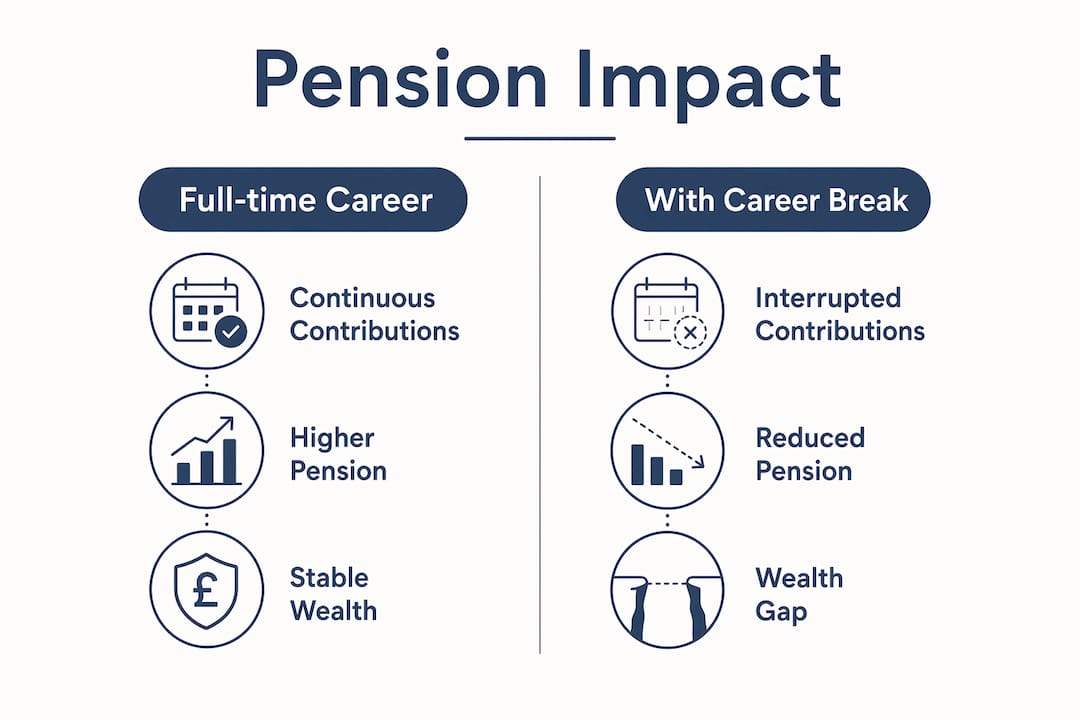
Pro Familia Schweiz highlights the underestimated long-term consequences of workforce absence, including reduced bargaining power and heightened old-age poverty risk. The Swiss Federal Council’s 2026 report confirms that family-friendly working conditions and accessible childcare are the most decisive factors in a successful return, not retraining alone.
How to plan your investments once you are back at work
Returning to work restores income, but rebuilding wealth requires a plan that accounts for the years of reduced contributions. The most powerful tool available is time, and the mathematics are stark: a monthly CHF 300 investment at a 5% annual return grows to roughly CHF 400,000 over 40 years, compared to approximately CHF 120,000 over 20 years.

Prioritise Pillar 3a with a securities component rather than a pure savings account. Over long horizons, the return differential between equities and cash is substantial, and the annual tax deduction makes the contribution itself immediately worthwhile. Pillar 3b, through broadly diversified ETFs, complements this by offering flexibility that the locked-in Pillar 3a does not.
Voluntary pension fund buy-ins deserve serious attention, particularly in the five to ten years before retirement when the tax advantages are greatest. A comprehensive pension gap analysis will show exactly how much you can buy in and what the tax saving looks like in your canton.
How to assess your risk tolerance after a career break
Risk tolerance is not fixed. A career break changes your financial position, your income certainty, and often your priorities, so the risk profile you held before the break may no longer reflect your actual situation.
Start by separating short-term liquidity from long-term capital. Money you may need within two years should not be in equities. Once your emergency fund covers three to six months of expenses, the remaining investable capital can be assessed against a genuine time horizon. A woman returning to work at 38 with a 27-year runway to retirement can absorb considerably more short-term volatility than her portfolio balance alone might suggest.
Ask yourself three practical questions: How stable is my new income? Do I have dependants whose costs could rise unexpectedly? And how did I actually feel, not theoretically, during the last period of financial uncertainty? Honest answers to these questions produce a more accurate risk profile than any standardised questionnaire. Independent financial advice for women in Switzerland can help translate those answers into a concrete asset allocation.
Which investment products suit women with irregular income?
Irregular income calls for flexible investment structures. Fixed monthly savings plans in ETFs work well precisely because they invest the same amount regardless of market conditions, which means you automatically buy more units when prices fall.
Pillar 3a contributions do not need to be made monthly. You can contribute a lump sum at any point in the tax year, which suits income that arrives unevenly. For broader financial independence planning, a combination of low-cost index funds, a Pillar 3a securities solution, and a cash buffer gives both growth potential and the flexibility to pause contributions during leaner months without penalty. General guidance on structuring these layers alongside insurance is available through resources such as financial planning guides that cover the interplay between investment and protection.
Marmot Finance: personalised wealth management for returning women
Rebuilding financial security after a career break is a specific challenge, and generic advice rarely addresses it well. Marmot Finance is Switzerland’s only FINMA-accredited wealth manager dedicated exclusively to women and families, offering fee-transparent, independent advice with no product commissions. Over 350 women have already worked with Marmot Finance to close pension gaps, build investment portfolios, and achieve genuine financial independence.
The approach combines personal advisory sessions with digital tools, including a Money Makeover Quiz that gives you a clear picture of where you stand today. Whether your priority is second-pillar optimisation, Pillar 3a investment selection, or building a diversified portfolio around an irregular income, the advice is tailored to your specific situation in Switzerland or Europe. Book a consultation to start with a clear, honest assessment of your financial position.
Key takeaways
Women returning to work in Switzerland face measurable pension gaps that require immediate, structured action across all three pillars to protect long-term financial independence.
Recommended
- Women Investment Portfolio Guide for Swiss Investors | Marmot Finance
- Women Investment Advice Explained: Your Swiss Guide | Marmot Finance
- Gender Gap Wealth Management: A Guide for Swiss Women | Marmot Finance
- Best Asset Classes for Women Investors in Switzerland | Marmot Finance

.webp)





.jpeg)



.png)

.svg)


