

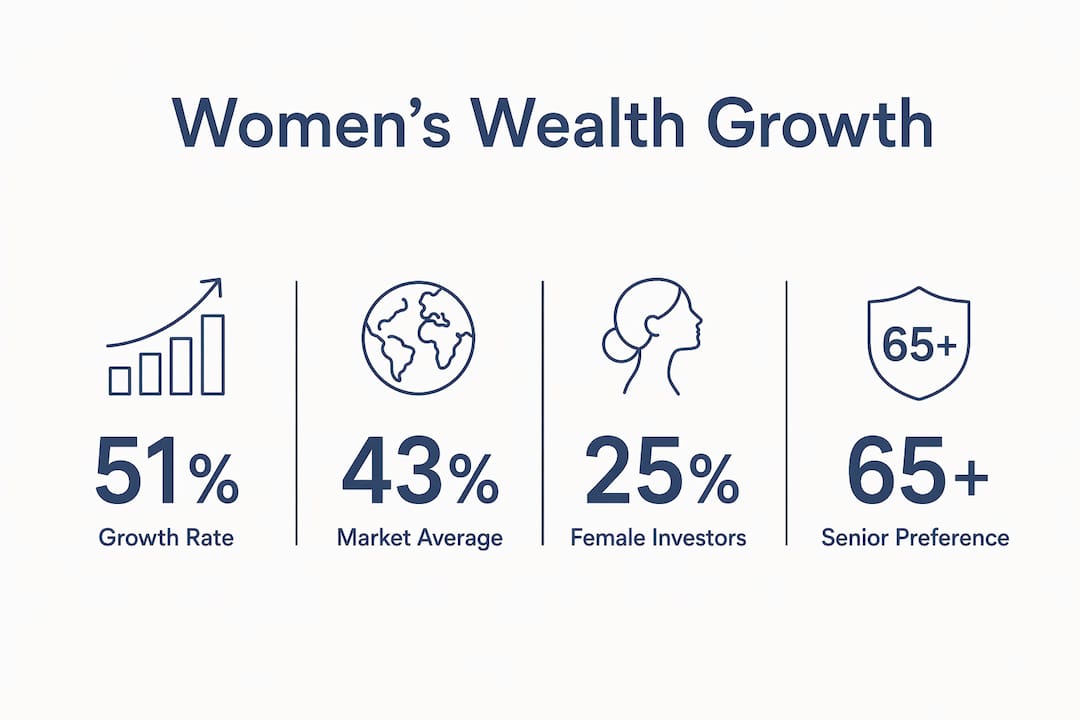
Women’s wealth grew by 51% between 2018 and 2023, outpacing overall global market growth of 43% in the same period. That gap is not a statistical footnote. It signals a structural shift in who controls capital, how it is deployed, and what financial institutions must do to remain relevant. In Switzerland, this shift is already visible in pension portfolios, investment platforms, and the growing number of women taking deliberate control of their long-term financial futures.
How women’s wealth is rising faster than the market
The rise of the female investor is one of the most consequential trends in global wealth management, and Switzerland sits at the centre of it. Women are building wealth through employment, entrepreneurship, and inheritance at a pace the industry has not seen before. The 51% growth in female-controlled wealth versus 43% for the broader market reflects not just rising incomes, but a generational change in financial confidence and ambition.
Key facts anchoring this trend:
- Global female-controlled wealth grew by 51% between 2018 and 2023, versus 43% for the overall market.
- In Switzerland, 67% of women who invest use Pillar 3a pension solutions as their primary vehicle.
- 94% of Swiss women say that money gives them a sense of security, making safety the dominant motivator.
- By 2030, women in Europe and Switzerland are projected to manage approximately 40–45% of retail investable assets.
- Only a minority of Swiss women currently invest actively or build wealth, pointing to a large, underserved population.
The implications for wealth management are direct. Financial institutions that continue to design products and communications around a predominantly male client base will lose ground. Those that adapt, by addressing women’s actual priorities around security, clarity, and values alignment, will capture a growing and loyal client segment.
What Swiss women actually want from their investments
Swiss women’s investment behaviour is shaped by a clear set of priorities that differ meaningfully from the patterns typically seen among male investors. Security is the foremost goal for 57% of women when managing money, well ahead of long-term wealth building at 34% and yield at 21%. This is not risk aversion in the pejorative sense. It reflects a considered preference for stability over speculation, particularly given that many women carry greater responsibility for household financial management while also navigating career interruptions and part-time work.
The UBS Frauenperspektiven 2026 study, conducted by gfs.bern across 2,037 respondents, reveals a detailed picture of how Swiss women engage with investment products:
- Pillar 3a pension solutions are used by 67% of investing women, making them the dominant product category.
- Funds and ETFs follow at 52%, with individual stocks at 46%.
- Property investment is relevant for 37% of women investors, though it remains selective.
- Cryptocurrencies are used by just 4% of female investors in Switzerland, confirming that speculative assets hold little appeal.
Generational differences in how women seek financial information are also pronounced. Older women (65 and above) rely primarily on bank advisers, with 51% citing them as their main source. Younger women aged 16–39 turn more frequently to personal networks, with 33% using friends and family as their primary reference point. Nearly three in ten women report not actively seeking financial information at all, which points to a gap that education and accessible advisory services can address.
Pro Tip: If you are a woman beginning to think about investing in Switzerland, Pillar 3a is one of the most tax-efficient starting points available. Contributions reduce your taxable income, and the funds grow in a protected environment. Understanding this single product can meaningfully change your long-term financial position. Marmot Finance’s tailored portfolio strategies for women explain how to integrate it into a broader plan.
How financial institutions can genuinely connect with women investors
The wealth management industry has historically communicated in ways that resonate more with male clients than female ones. Performance tables, yield comparisons, and technical jargon dominate most advisory conversations, yet these are precisely the elements that fail to engage women, who consistently report wanting clarity, trust, and an understanding of how their money is actually being used.
The barriers are well documented. Among Swiss women who do not invest:
- 41% say they do not have enough money to invest.
- A significant proportion cite uncertainty about risks and insufficient knowledge about investment products.
- Distrust of banks and financial institutions is a recurring factor.
- Fear of making mistakes prevents many from taking the first step.
These are not problems solved by better marketing. They require a fundamental shift in how services are designed and delivered. Women want to understand their portfolios at a qualitative level, including how the companies they invest in are managed and what social or environmental impact those companies have. Framing investment conversations around security, life goals, and values, rather than benchmark returns, is what builds lasting trust.
Segmenting female clients by life stage also produces better outcomes. A woman in her thirties building a career has different priorities from one navigating divorce or managing an inheritance in her fifties. Financial institutions that treat women as a single homogeneous group miss the nuance entirely. Digital tools combined with personalised consultation, the model that Marmot Finance has built its practice around, address this by allowing advisers to tailor guidance to each client’s actual circumstances.
Pro Tip: When evaluating a financial adviser or wealth manager, ask directly how they approach goal-setting for women clients. If the answer focuses exclusively on portfolio returns, that is a signal the service has not been designed with your priorities in mind.
What the 2030 projections mean for Switzerland’s financial future
The forecast that women will manage approximately 40–45% of retail investable assets in Europe and Switzerland by 2030 carries significant consequences for how capital flows across the economy. This is not a distant scenario. The trajectory is already established, driven by rising female participation in senior professional roles, growing rates of female entrepreneurship, and the intergenerational transfer of wealth to women through inheritance.
Several consequences are already emerging:
- Demand for sustainable and ethically aligned investment products is rising, driven in part by women’s stronger preference for portfolios that reflect their values.
- Corporate governance is coming under greater scrutiny as more female investors ask detailed questions about how companies are run.
- Asset allocation patterns are shifting toward diversified, lower-volatility structures that prioritise capital preservation alongside growth.
- Financial service providers are redesigning client interfaces and advisory models to accommodate women’s preference for clarity and transparency.
- The gender wealth gap, while still substantial globally, is narrowing in markets where women have strong access to professional financial advice and pension structures.
Switzerland’s Pillar 3a system gives Swiss women a structural advantage in wealth building that many European counterparts lack. The challenge is that only a minority of women currently use it to its full potential. Closing that gap, through education, accessible advice, and culturally sensitive communication, is one of the most direct levers available for improving female financial outcomes in Switzerland.
Practical steps for Swiss women building their investment foundation
The most common barrier between Swiss women and investing is not a lack of money or intelligence. It is a lack of confidence, compounded by the perception that finance is complicated or not designed for them. That perception is understandable given how the industry has historically communicated, but it does not reflect reality. Building a solid investment foundation is genuinely achievable with the right starting points.
Practical steps worth considering:
- Start with financial literacy, not products. Understanding the basics of compound growth, risk and return, and asset diversification gives you a framework for every decision that follows. Resources from Swiss consumer finance organisations and FINMA-regulated advisers provide reliable, unbiased starting points.
- Use Pillar 3a as your first investment vehicle. It is tax-efficient, regulated, and available to anyone with earned income in Switzerland. Even modest annual contributions accumulate meaningfully over a working life. Marmot Finance’s guide to gender gap wealth management covers how to use it effectively.
- Diversify across asset classes aligned with your risk tolerance. Funds and ETFs offer broad market exposure without requiring you to select individual stocks. They suit women’s documented preference for stability while still delivering long-term growth.
- Address the psychological barriers directly. The belief that you need more money before you can start investing is one of the most common and most costly misconceptions. Starting small and building gradually is more effective than waiting for a perfect moment.
- Choose an adviser who communicates in plain language. Transparency about fees, strategy, and risk is non-negotiable. If you leave a meeting more confused than when you arrived, the problem is not you.
- Review your plan at life transitions. Marriage, divorce, career change, and inheritance each alter your financial picture. A good adviser will prompt these reviews; a great one will have already built them into your plan.
Pro Tip: Marmot Finance offers a Money Makeover consultation specifically designed for women and families in Switzerland. It is a practical starting point for understanding where you stand and what your next steps should be, without jargon or pressure.
Profiles of women reshaping Swiss investment culture
Switzerland has produced a number of women who are actively changing how investment is practised and perceived. Their stories illustrate that the rise of female investors is not only a demographic trend but also a professional one.
Evelyne Pflugi founded The Singularity Group, an investment firm built on rule-based, technology-driven methods that deliberately reduce the emotional biases prevalent in traditional fund management. Her approach rejects the intuition-led decision-making that characterises much of the industry in favour of systematic processes grounded in data. Pflugi received the Bold Woman Award by Veuve Clicquot in 2025, a recognition that also drew attention to the broader importance of female role models in finance. Her firm now employs more women than men, which she attributes not to a deliberate gender policy but to a shared curiosity and drive to build something genuinely different. She has noted that unconscious bias in recruitment remains a real obstacle, with men often presenting themselves more confidently in interviews, and that confidence being mistaken for competence.
Maike Stroetmann, founder of Independista, represents a different but equally important dimension of this shift. Working as a department head in the construction industry by day, she built a financial coaching platform specifically for women navigating Switzerland’s financial system, initially targeting expats but quickly expanding to Swiss women facing the same challenges. Her observation that women are strong savers but invest less frequently, often due to fear of risk, reflects the broader pattern documented in the UBS Frauenperspektiven 2026 study. Stroetmann’s structured workshop model takes participants from financial basics to sustainable investing, with a deliberate emphasis on practical action over theoretical knowledge.
Both profiles share a common thread: the conviction that financial knowledge is not inherently complicated, but that it has historically been presented in ways that exclude women. Changing that presentation, whether through technology, education, or advisory design, is where the real work lies.
Which digital tools and platforms are women investors choosing?
Women’s adoption of digital investment tools has accelerated, though their preferences differ from the patterns typically associated with male retail investors. The emphasis is on clarity, control, and alignment with personal values rather than on trading frequency or speculative opportunity.

ETF platforms and pension management tools are the most widely used digital investment interfaces among Swiss women, consistent with the dominance of Pillar 3a and fund-based investing in their portfolios. These platforms offer transparent cost structures, broad diversification, and straightforward interfaces that suit women’s preference for understanding what they own and why. The best asset classes for women in Switzerland typically map directly onto the products these platforms support.
Robo-advisory services have gained traction among younger women, particularly those aged 25–40 who are comfortable with digital interfaces but lack the time or inclination to manage portfolios manually. The rule-based, systematic nature of robo-advisory aligns well with the technology-driven investment approach that successful female investors like Evelyne Pflugi have championed at an institutional level. Removing emotional decision-making from the process tends to produce more consistent outcomes, a benefit that applies equally to individual investors and professional fund managers.
Social and community-based financial platforms are also growing in relevance, particularly for younger Swiss women who rely on personal networks for financial education. Platforms that combine peer discussion with structured learning content address both the information gap and the confidence gap simultaneously. The key distinction between platforms that genuinely serve women and those that simply market to them is whether the content is designed around women’s actual financial goals or merely repackaged general advice with different imagery.
Marmot Finance’s hybrid model, combining digital tools with personal consultation, reflects the evidence that women value both accessibility and human connection in their financial relationships. Neither a purely digital nor a purely advisory approach captures the full picture.
How women’s investment outcomes compare with men’s
The evidence on gender differences in investment outcomes is more nuanced than popular narratives suggest. Women do not simply invest less and earn less. The picture depends heavily on the time horizon, the asset classes involved, and the degree to which emotional bias influences decision-making.
Swiss women, as the UBS Frauenperspektiven 2026 study documents, approach investment decisions with greater caution and deliberation than men. Men in the same study weighted yield and wealth building more heavily, while women prioritised security and stability. This difference in orientation does not translate straightforwardly into worse outcomes. Portfolios built around stability and diversification tend to suffer smaller drawdowns during market corrections, which matters considerably for long-term compounding.
The gap that does disadvantage women is not in their investment decisions but in their participation rate. Only around half of Swiss women invest at all, even occasionally, compared to higher rates among men. The women who do invest, particularly those using systematic, rules-based approaches, often achieve outcomes that compare favourably with male peers over longer periods. The problem is that too many women never start, held back by the confidence gap, the perception that they lack sufficient capital, and the mental load of managing competing demands on their time and attention.
Women also tend to trade less frequently than men, which reduces transaction costs and limits the damage done by reactive decision-making during volatile periods. This behavioural pattern, often framed as caution, is in practice a structural advantage for long-term investors. The financial advice for women that Marmot Finance provides is built around these realities, not around a generic investment framework applied regardless of gender.
Sociocultural factors shaping how Swiss women invest
Switzerland’s specific social and cultural context shapes female investment behaviour in ways that go beyond individual psychology. Structural factors, including the persistence of part-time work among women, the organisation of household financial responsibilities, and the country’s particular pension architecture, all influence how and when women engage with investment decisions.
The UBS Frauenperspektiven 2026 study found that 45% of Swiss women handle routine financial tasks such as bill payments and household administration themselves, while strategic decisions are more often made jointly. For investment and portfolio decisions specifically, 44% of partnered women make these jointly with their partner. This pattern means that many women are highly competent at operational financial management but less frequently in the position of making independent long-term investment decisions. When a relationship ends through divorce or bereavement, this can leave women financially exposed in ways that earlier, more independent engagement with investing would have prevented.
The mental load factor is also significant. Thirty-six percent of Swiss women report that financial matters constitute a large part of their daily mental burden, a figure considerably higher than among men. Nearly three in ten women feel too busy to engage with financial or pension planning regularly. These are not excuses for inaction; they are real constraints that financial services must accommodate rather than ignore. Advisers who offer concise, time-efficient consultations with clear follow-up materials are far more likely to retain female clients than those who require lengthy, complex engagement processes.
Cultural attitudes toward money as a private topic also reduce the likelihood that women will seek financial advice proactively. Switzerland’s traditionally reserved approach to discussing personal finances means that many women lack the informal peer conversations about investing that might otherwise build confidence. Platforms and communities that normalise these conversations, including those focused on family financial milestones and long-term planning, play a genuine role in shifting this dynamic. Financial wellness, understood broadly as confidence, knowledge, and access to good advice, is increasingly recognised as a prerequisite for women’s economic independence, not a luxury.
Key takeaways
Women’s wealth is growing faster than the overall market, and Switzerland’s financial institutions must adapt now to serve this expanding client base effectively.
Recommended
- Gender Gap Wealth Management: A Guide for Swiss Women | Marmot Finance
- Best Asset Classes for Women Investors in Switzerland | Marmot Finance
- Women Investment Advice Explained: Your Swiss Guide | Marmot Finance
- Women Investment Portfolio Guide for Swiss Investors | Marmot Finance

.webp)





.jpeg)



.png)

.svg)


