

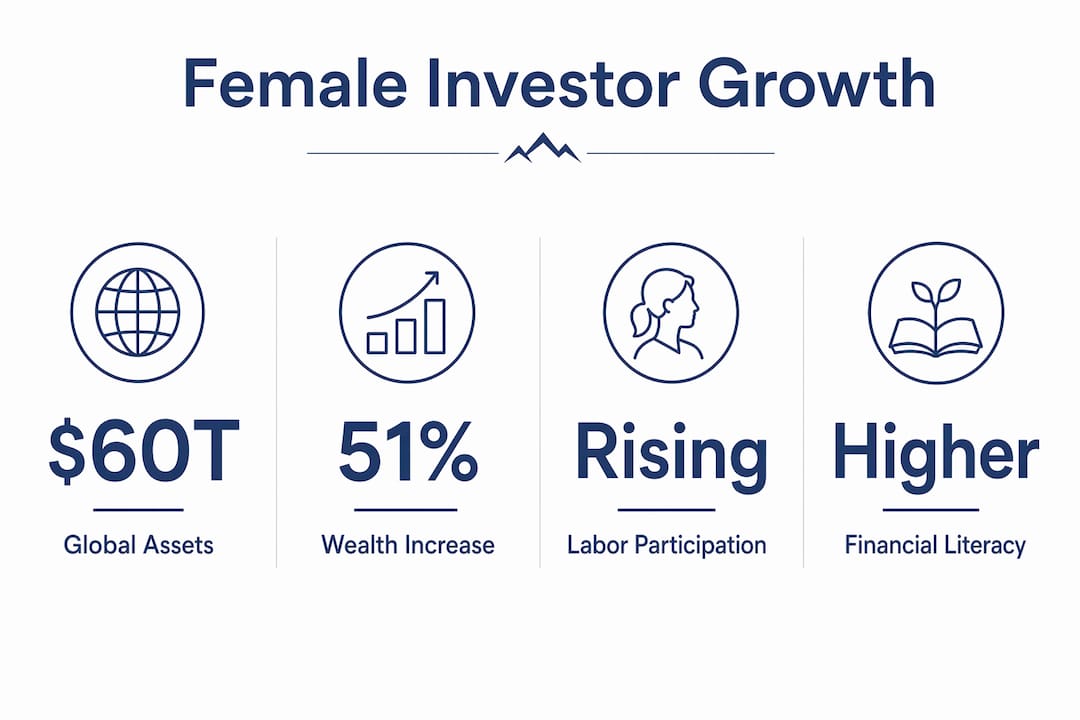
Women now control an estimated $60 trillion in assets under management globally, and that figure grew faster than total global wealth between 2018 and 2023. The rise of the female investor is not a trend in the making — it is already reshaping capital flows, advice models, and product design across wealth management. For Switzerland, where the pension system, inheritance law, and household structures create specific dynamics, the implications are both urgent and concrete.
Between 2018 and 2023, global financial wealth rose 43% while wealth controlled by women rose 51%. Women currently control roughly one-third of retail financial assets in the EU and the US. Swiss advisers and women themselves need to act now because the gap between asset ownership and active management remains wide, and the cost of inaction compounds every year.
Immediate implications for Switzerland:
- An estimated 53% of assets controlled by women remain unmanaged, compared with 45% for men, representing a significant unmet advice demand.
- Closing that gap could represent roughly a $10 trillion global opportunity by 2030.
- Swiss women show strong interest in security-focused products, yet about 38% report they have not invested and are not planning to, often citing perceived complexity as the barrier.
- Capital flows into ESG and multi-asset strategies are increasingly driven by female investors, reshaping product priorities for Swiss wealth managers.
- The advice gap is both a commercial opportunity and a risk: assets left unmanaged lose purchasing power against Swiss inflation and miss compounding.
What is driving the growth in women’s wealth?
Several structural forces have converged to accelerate female-controlled wealth, and understanding them helps both advisers and women anticipate what comes next.
The most immediate driver is intergenerational wealth transfer. As the baby boomer generation ages, a significant share of inherited assets passes to women, whether as surviving spouses or as direct heirs. Divorce and household restructuring add to this: women who separate from long-term partnerships often take control of assets they previously left to a spouse to manage. These are not gradual shifts — they are discrete, high-value events that move substantial sums in a short period.
Economic participation has also changed materially. Women’s labour force participation in Switzerland has risen steadily, and more women now hold senior executive and board positions than at any point in the country’s history. Entrepreneurship is another channel: women-founded businesses generate wealth that eventually needs professional management, even if Swiss venture capital still directs just over 7% of funding to companies with female CEOs, a figure that signals how much room remains for growth. The gender pay gap in Switzerland has narrowed, though it has not closed, and higher earnings translate directly into greater investable surplus.

Cultural and informational shifts matter too. Younger cohorts of Swiss women are entering the workforce with higher financial literacy than previous generations, partly because digital platforms have lowered the barrier to learning. Fintech tools, online communities, and accessible educational content have made investing feel less like a specialist domain. The number of female direct clients at Saxo Bank Schweiz rose 40% between 2021 and 2026, and the female share of new funded accounts reached 28.9% on a 2026 year-to-date basis — a clear signal of accelerating participation.
Switzerland’s three-pillar pension system adds a specific dimension. Women who take career breaks for caregiving accumulate smaller pillar 2 (BVG) balances than men, which creates a structural shortfall that voluntary pillar 3a contributions can partially address. Awareness of this gap is growing, and it is motivating more women to engage with their pension planning earlier and more deliberately.
How female investors in Switzerland actually behave
The behavioural profile of female investors is more nuanced than the “risk-averse” shorthand that still circulates in some advisory circles. Understanding it properly changes how portfolios should be built and how conversations should be framed.
Asset preferences and allocation tendencies:
- Pension products (pillar 2 and pillar 3a) are the most common entry point for Swiss women, often because contributions are automatic rather than discretionary.
- Funds and ETFs are the preferred vehicle for those who do invest actively, reflecting a preference for diversification over single-stock selection.
- Property remains a significant store of wealth, particularly for older cohorts, though Swiss property prices make direct ownership increasingly difficult for younger women.
- Crypto adoption among female investors is lower than among male peers, consistent with the security-first orientation documented in Swiss surveys.
Risk preferences and time horizons deserve a more careful reading. Swiss surveys consistently show that security is the top criterion for 57% of women, ahead of long-term accumulation or returns. That does not mean women are unwilling to invest — it means they need a clear explanation of how a given strategy protects capital before they are comfortable accepting volatility. Women who do invest tend to hold positions longer and trade less frequently than male counterparts, which is a structural advantage in compounding terms.
The case for multi-asset strategies is particularly strong. Saxo Bank Schweiz data shows that multi-asset female investors achieved a 1.1 percentage point higher average return and were 12 percentage points more likely to end the year with a positive return compared with single-asset female investors. Diversification, not higher risk, is the performance driver.

Interest in ESG and sustainable investing is consistently higher among female investors than among male peers. Values-driven allocation — directing capital towards companies with strong environmental, social, and governance records — resonates with the security-and-stability orientation, because ESG screening is often framed as a risk-management tool as much as an ethical one.
Digital platforms and peer communities have meaningfully increased participation. Women who engage with online investment communities or fintech platforms are more likely to open accounts and more likely to diversify. The social dimension of investing, sharing knowledge and normalising the conversation, reduces the perceived complexity that holds back the 38% who have not yet started.
Pro Tip: When advising female clients on diversification, introduce one new asset class at a time rather than presenting a fully restructured portfolio. Framing each addition as a risk-reduction step, rather than a return-enhancement move, aligns with the security-first orientation and tends to produce better engagement and follow-through.
What the rise of female investors means for markets and advisers
The commercial implications of female investors growth are substantial, and wealth managers who treat this as a niche rather than a mainstream priority are misreading the data.
The most direct effect is on capital flows. As more women take control of inherited or accumulated assets, demand for multi-asset funds, stewardship strategies, and impact-oriented products will grow. Firms that have already built credible ESG offerings are better positioned to capture this flow. Those that have not will find it harder to retain female clients who are increasingly informed about what they want.
The advice gap is the single largest addressable opportunity. Closing the management gap between female and male-controlled assets could represent roughly $10 trillion globally by 2030. In Switzerland, where private wealth is concentrated and the pillar system creates regular touchpoints, advisers who engage women early — at career transitions, inheritance events, or retirement planning milestones — will build relationships that compound over decades.
Pricing and communication models need to adapt. Women in Switzerland tend to prefer personal advice but a significant share do not actively seek information, which means outreach must combine education with genuine invitation rather than waiting for inbound enquiries. Jargon-heavy proposals, product-first conversations, and fee structures that are not clearly explained all create friction that disproportionately affects female clients.
The most effective advisory change is not a new product — it is a different conversation. Advisers who lead with goals, values, and life events rather than portfolio construction retain female clients at materially higher rates and receive more referrals.
For product teams, the implication is clear: women-focused wealth management is not a marketing exercise. It requires genuinely different onboarding flows, communication cadences, and portfolio defaults. Firms that have built these capabilities, including FINMA-accredited managers with a dedicated women-and-families proposition, are already seeing the commercial benefit.
Pro Tip: For product and advisory teams: audit your client onboarding materials for jargon density and goal-orientation. Replace product-led language (“we offer a balanced fund”) with outcome-led language (“this approach is designed to protect your capital while growing it steadily over ten years”). The change is small; the effect on client confidence is significant.
What this means specifically for women in Switzerland
Switzerland’s legal and pension framework creates specific planning considerations that are distinct from the broader European picture. Women navigating these structures benefit from understanding the key leverage points.
Pillar 2 and pillar 3a dynamics:
Women who take career breaks, reduce hours for caregiving, or work part-time accumulate materially lower BVG (pillar 2) balances than men in equivalent earnings brackets. The threshold below which pillar 2 contributions are not mandatory means that part-time workers, a group disproportionately composed of women, may have no occupational pension coverage at all. Voluntary pillar 3a contributions are the most tax-efficient way to address this shortfall: contributions are deductible from taxable income, and the account grows tax-free until withdrawal.
Inheritance and intergenerational transfer in Switzerland follow cantonal as well as federal rules, and the 2023 revision to Swiss inheritance law expanded testamentary freedom by reducing the mandatory share for descendants. Women who receive inherited assets should take specific advice on whether to consolidate accounts, how to handle foreign assets within a Swiss tax return, and whether a postnuptial agreement or estate plan needs updating.
A short checklist for your next adviser meeting:
- Review your pillar 2 statement and identify any gaps from career breaks or part-time periods.
- Confirm whether you are making annual pillar 3a contributions and whether the amount is optimised for your tax bracket.
- Ask your adviser to show you your current asset allocation across all accounts, including pension assets.
- Clarify how your assets are titled and whether your estate plan reflects your current wishes.
- Ask specifically about ESG or sustainable fund options within your existing pension or investment accounts.
- If you have received or expect to receive an inheritance, ask for a consolidation review before making any allocation decisions.
Swiss women can find authoritative guidance on pension rights and inheritance rules through the Federal Social Insurance Office (FSIO) and the Swiss Federal Tax Administration. For investment-specific questions, FINMA’s register of authorised managers provides a starting point for verifying adviser credentials.
Swiss evidence on outcomes: what the data shows
The evidence from Swiss and European platforms points consistently in one direction: women who invest in diversified, multi-asset portfolios achieve better outcomes than those who hold a single asset class or remain entirely in cash.
Saxo Bank Schweiz’s client data provides the clearest quantitative illustration available for the Swiss market. Multi-asset female investors outperformed single-asset female investors by 1.1 percentage points on average annual return and were 12 percentage points more likely to close the year in positive territory. The implication is not that women need to take more risk — it is that concentration risk, often in a single fund or a single property, is the primary drag on outcomes.
Women who hold a diversified portfolio across equities, bonds, and real assets are not taking more risk than those who hold cash or a single fund. They are taking different risk, spread across uncorrelated sources, which historically produces more stable long-term outcomes.
Marmot Finance’s experience with over 350 women in Switzerland reinforces this. Clients who engage with a tailored portfolio strategy that incorporates their pension assets, voluntary savings, and any inherited wealth alongside their risk profile tend to see a clearer picture of their financial position within the first year of engagement. The process of consolidating accounts and mapping goals to specific asset allocations is itself valuable, independent of market returns.
Marmot collects client outcomes through structured annual reviews, with all data anonymised and aggregated before any reporting. No individual client data is shared externally.
Pro Tip: If you are currently invested in a single fund or a single asset class, the most practical first step is not to switch — it is to add. Introducing one complementary asset class, such as a global bond fund alongside an equity fund, reduces concentration risk without requiring a full portfolio restructure. Use a financial planning calculator to model how different allocations affect your projected outcomes over a ten-year horizon.
A practical playbook: what to do next
Whether you are a woman starting to invest or an adviser looking to serve female clients better, the following steps are grounded in the evidence above.
For women in Switzerland:
- Start with your pension. Log into your BVG account and request a pension projection. If you have gaps from career breaks, ask your pension fund whether you can make voluntary buy-in contributions (Einkauf).
- Open or maximise a pillar 3a account. The annual contribution limit is set by the Federal Social Insurance Office and changes periodically; check the current figure before the tax year ends.
- Map all your accounts. List every savings account, investment account, and pension account you hold. Many women discover they have more assets than they realised once they consolidate the picture.
- Check your asset allocation. If everything is in cash or a single fund, that is concentration risk. Ask your adviser or use an online tool to model a simple two or three-asset allocation.
- Ask about fees. Request a clear breakdown of all charges, including fund management fees, platform fees, and adviser fees. In Switzerland, these are regulated but not always proactively disclosed.
- Consider ESG options. Most Swiss pension funds and banks now offer sustainable investment options within pillar 3a and discretionary accounts. Ask specifically whether your current allocation includes them.
- Review your estate plan. If you do not have a will or have not reviewed it since a major life event, this is the highest-priority non-investment action on the list.
Questions to ask your adviser — and the answers you should expect:
- “What is my current asset allocation across all accounts, including pension?” A good adviser can answer this immediately or within one meeting.
- “How does my pillar 2 balance compare with what I would need at retirement?” The answer should include a specific projection, not a general comment.
- “What are the total fees I am paying?” The answer should be a percentage of assets under management, broken down by layer.
- “Do you have experience advising women through inheritance or divorce?” Experience with life-event planning is a meaningful differentiator.
For advisers engaging female clients:
- Lead every initial meeting with goals and life events, not portfolio construction.
- Provide written summaries after meetings in plain language, without acronyms.
- Proactively raise pillar 3a and BVG gap analysis for any female client who has taken a career break.
- Build a referral network that includes family lawyers and tax advisers, because life events that trigger asset movement rarely involve only one professional.
- Offer educational content as a first touchpoint for women who are not yet ready to invest. The women and finance resources at Marmot Finance illustrate what this looks like in practice.
Key takeaways
Women’s wealth is growing faster than total global wealth, and the advice gap in Switzerland represents both a significant risk for women and a material opportunity for advisers who engage early and thoughtfully.
Why the conventional wisdom on female investors still gets it wrong
The standard narrative about female investors tends to land in one of two places: either it treats women as a homogeneous group defined by risk aversion, or it frames the entire topic as a social good story with limited commercial substance. Both framings miss the point, and both lead to poor advisory practice.
The risk-aversion framing is the more damaging of the two, conflating a preference for security with an unwillingness to invest, which are not the same thing. A woman who wants her capital protected is not asking for a savings account — she is asking for a portfolio that is constructed with downside management in mind. That is a legitimate and sophisticated investment objective, and it maps well to multi-asset strategies, capital-protected structures, and income-oriented allocations. Advisers who hear “I don’t want to lose money” and respond with a cash recommendation are failing their clients.
The social good framing, meanwhile, tends to produce marketing campaigns rather than product changes. Firms that launch a “women’s wealth” initiative without changing their onboarding process, their fee transparency, or their communication style will not retain female clients. The women who are now accumulating and inheriting significant assets are informed, and they will move their business to advisers who treat them as such.
What the data actually shows is that female investors, when properly served, are excellent long-term clients. They trade less, hold longer, and refer more. The women’s wealth lifecycle from first salary to retirement is a multi-decade relationship, and advisers who engage at the right moments — career transitions, inheritance events, pension planning milestones — build the kind of client relationships that are genuinely difficult to replicate.
The opportunity in Switzerland is real and it is not going away. The question is whether advisers and wealth managers will build the capabilities to serve it properly, or whether they will continue to treat it as a secondary priority while the assets move elsewhere.
Marmot Finance: wealth management built for women in Switzerland
Most wealth management services were not designed with women in mind. Marmot Finance was. As Switzerland’s only FINMA-accredited wealth manager dedicated to women and families, Marmot Finance combines personal consultations with digital tools to build portfolios that reflect each client’s goals, pension position, and values — whether that means integrating pillar 3a planning, navigating an inheritance, or building a diversified investment strategy from scratch.
Over 350 women have already worked with Marmot Finance to clarify their financial position and build a plan that holds up through life’s major transitions. The service covers CHF, EUR, and USD accounts, and is available to Swiss residents and European clients with cross-border planning needs.
The first step is a conversation. Through expert wealth management at Marmot Finance, you can book an initial meeting to discuss your current position, your goals, and what a tailored strategy would look like for your situation. There is no obligation, and the meeting is designed to give you clarity, not to sell you a product.
Key sources and further reading
The following studies and reports were used in preparing this article. Swiss and European sources are prioritised; all links are to primary or authoritative secondary sources.
- McKinsey & Company — “The new face of wealth: The rise of the female investor”: The primary global source for headline statistics on female-controlled assets, the advice gap, and the $10 trillion opportunity. Read the report.
- UBS / GFS Bern — “Women’s Perspectives 2026”: The most detailed Swiss-specific survey on women’s investment attitudes, motivations, and barriers. Covers security preferences, non-investor profiles, and advice-seeking behaviour. Access the report.
- Saxo Bank Schweiz — “Women investors are growing fast and the next opportunity is diversification”: Swiss platform data on female client growth, multi-asset performance differentials, and the compounding argument for diversification. Read the article.
- SWI swissinfo.ch — “Women-led start-ups attract just 7% of Swiss venture capital funding”: Swiss venture capital allocation data illustrating where gender gaps in capital access persist. Read the article.
- Startupticker.ch — “Business Angel Groups advocate for diversity”: Survey evidence on barriers facing aspiring female business angels in Switzerland, including skills gaps and network access. Read the article.
- World Economic Forum — “Women shape, influence and revolutionise financial markets”: Broader international context on the structural shift in women’s financial influence and market participation. Read the article.
- Impact Wealth — “The $68 trillion wealth transfer offers women a path to financial empowerment”: Background on the intergenerational wealth transfer and its implications for female asset ownership. Read the article.
This article is general information, not financial or legal advice. Tax rules, pension thresholds, and inheritance regulations change; confirm the details relevant to your situation with a qualified professional or the relevant Swiss authority.
Recommended
- Best Asset Classes for Women Investors in Switzerland | Marmot Finance
- Women Investment Advice Explained: Your Swiss Guide | Marmot Finance
- Women Investment Portfolio Guide for Swiss Investors | Marmot Finance
- Gender Gap Wealth Management: A Guide for Swiss Women | Marmot Finance

.webp)





.jpeg)



.png)

.svg)


