

Women investors in Switzerland are increasingly choosing to align their portfolios with their personal values, and the financial case for doing so is stronger than many assume. Values-based investing, often discussed under the broader ESG framework (Environmental, Social, and Governance), means selecting investments not only for their financial return but for what they stand for: climate responsibility, fair labour practices, gender equality, and sound corporate governance. This is not a niche preference. Research from UBS shows that security and stability motivate 57% of Swiss women investors, compared to just 21% who cite returns as their primary driver. Values-based investing speaks directly to that priority, offering a way to grow wealth while managing risk and contributing to outcomes that matter.
The core values Swiss women most commonly prioritise when investing include:
- Environmental sustainability, particularly climate protection and CO2 reduction
- Social factors such as fair wages and gender equality in the workplace
- Transparent corporate governance and accountability
- Long-term financial security for themselves and their families
- Avoidance of speculative or opaque investment products
These priorities are not abstract. They shape real portfolio decisions, from the choice of pension products to the selection of funds, and they have measurable consequences for long-term wealth accumulation.
What ESG investing actually means, and why it resonates with women
ESG stands for Environmental, Social, and Governance, the three lenses through which a company or fund is assessed beyond its balance sheet. Environmental criteria examine a firm’s carbon footprint, waste management, and resource use. Social criteria cover labour standards, community impact, and diversity. Governance looks at board composition, executive pay, and transparency. Together, these factors give investors a fuller picture of where their money is going and what risks it carries.
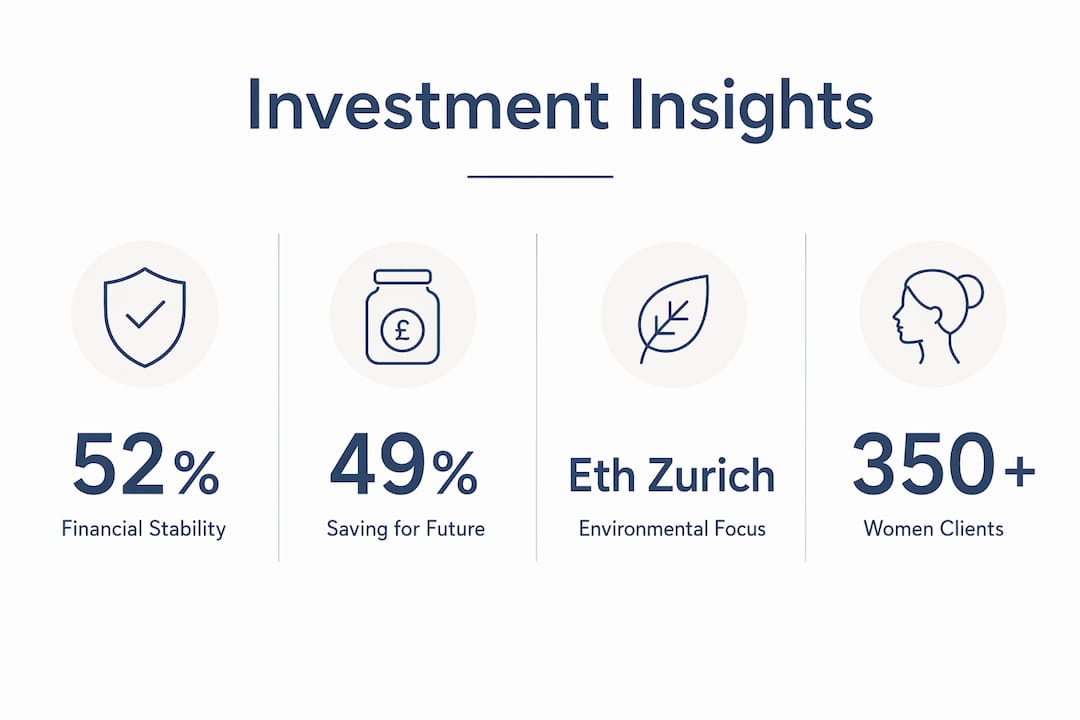
Research from ETH Zurich confirms that Swiss investors place the greatest weight on environmental factors, particularly climate protection and CO2 reduction, followed by social dimensions such as fair wages and gender equality. This hierarchy aligns closely with the values Swiss women report as most important to them personally. The overlap between personal conviction and investment criteria is precisely what makes ESG a natural fit.
One area that deserves more attention is the question of labels and transparency. Swiss investors strongly prefer mandatory government-backed labels that cover multiple sustainability dimensions, similar to the Swiss Climate Scores framework. This preference reflects a genuine concern about greenwashing, where funds claim sustainability credentials they cannot substantiate. For women who are already cautious about complexity and trust, the absence of clear, regulated labelling has historically been a real barrier to entry.
Common misconceptions worth addressing directly:
- Values-based investing does not automatically mean lower returns (the evidence on this is covered in the next section)
- ESG funds are not all the same; “light-green” and “dark-green” funds differ substantially in their sustainability commitments
- Starting with accessible products like Pillar 3a pension solutions or broad ESG-focused ETFs is entirely valid and widely practised among Swiss women
Pro Tip: If you are new to values-based investing, begin with a Pillar 3a pension solution that offers a sustainable fund option. This gives you a tax-efficient entry point with a regulated product, before expanding into broader ETF or equity portfolios as your confidence grows.
Do ESG portfolios actually deliver competitive returns?
The concern that values-based investing requires sacrificing returns is one of the most persistent misconceptions in personal finance, and the evidence does not support it. A meta-analysis of over 1,000 research papers by NYU Stern found that ESG portfolios match or outperform conventional funds in 59% of cases, with the positive effect becoming more pronounced over longer time horizons.
The same body of research identifies why this happens. Companies with strong ESG practices tend to manage risk more carefully, invest in operational efficiency, and build stronger relationships with employees, suppliers, and customers. These are not soft benefits; they translate into better return on equity and return on assets over time. A cross-sectional study cited in the NYU Stern analysis found returns up to 3.8% higher per standard deviation of ESG score in the mid and long term.
Statistic to note: During the first quarter of 2020, 24 of 26 ESG index funds outperformed their conventional counterparts through the COVID-19 market downturn, according to Morningstar data cited in the NYU Stern review. By the end of the third quarter, 45% of ESG-focused funds were outperforming their index.
This downside protection is particularly relevant for women investors in Switzerland, whose primary motivation is financial security rather than aggressive growth. An investment approach that holds up better during crises, while still generating competitive long-term returns, fits that preference precisely. Swiss retail investors appear to recognise this trade-off: research from ETH Zurich shows they are willing to accept up to 1.6 percentage points less return annually for highly sustainable products, suggesting they place genuine value on sustainability beyond pure financial gain.
How women’s investment preferences shape their wealth management choices
The investment behaviour of Swiss women is shaped by a distinct set of motivations and constraints that differ meaningfully from the broader market. Understanding this is not a matter of stereotyping; it is a matter of designing financial strategies that actually work.

According to UBS research, 52% of Swiss women want to remain financially stable despite rising costs, and 49% want to save for the future and feel more secure. Wealth accumulation for its own sake ranks far lower: only 22% cite building assets as a primary goal, compared to 37% of men. This is not a lack of ambition. It reflects a different relationship with money, one oriented towards protection, family security, and purposeful impact rather than portfolio maximisation.
The barriers to investing are equally specific. 41% of Swiss women cite insufficient funds as the main reason they do not invest, followed by uncertainty about risk (26%) and a feeling of not knowing enough (22%). A lack of trust in banks is mentioned by 21%. These are structural and psychological hurdles, not signs of disinterest.
Practical investment preferences among Swiss women reflect this caution:
- Pillar 3a pension solutions are the most widely used investment product, chosen by 67% of women who invest
- Funds and ETFs follow at 52%, with individual stocks at 46%
- Real estate plays a selective but meaningful role at 37%
- Cryptocurrencies remain marginal at 4%
- Trust in the provider and clarity of information are cited as more important than performance rankings alone
Clear financial education shifts behaviour in a measurable way. ETH Zurich research found that a structured financial literacy programme increased uptake of highly sustainable funds by 6%, moving investors from light-green to dark-green options. The implication for wealth managers is direct: women who receive clear, jargon-free information about values-based options are more likely to act on their existing preferences. The interest is already there; what is often missing is the right guidance.
Understanding the gender gap in wealth management helps explain why a tailored approach produces better outcomes than a generic one. Women’s investment decisions are grounded in a coherent set of priorities, and a financial strategy built around those priorities tends to generate both greater engagement and greater long-term stability.
Values-based investing for Swiss women: how Marmot Finance approaches it
Marmot Finance is the only FINMA-accredited wealth manager in Switzerland dedicated exclusively to women and families. That focus is not cosmetic. It shapes every aspect of how portfolios are constructed, how advice is delivered, and how clients are supported over time.

The approach at Marmot Finance combines personal consultation with digital tools, allowing each client’s portfolio to reflect both her financial situation and her values. ESG criteria are integrated from the outset, not added as an afterthought. A client who prioritises climate action will have that reflected in her fund selection. One who cares about gender equality in corporate governance will see that in the companies her portfolio holds. The process starts with understanding what matters to the individual, then building a strategy around it.
Marmot Finance’s work with over 350 women in Switzerland has produced consistent findings. Women who receive clear, structured guidance on values-based options tend to move from cautious saving into active, purposeful investing. The shift is not dramatic or sudden; it is incremental, built on growing confidence and a clearer understanding of what their money is doing. Financial independence, rather than a distant aspiration, becomes a concrete goal with a plan attached to it.
Steps Swiss women can take to begin or refine a values-based investment strategy with Marmot Finance:
- Start with a personal financial review to clarify current assets, goals, and values priorities
- Identify which ESG dimensions matter most, whether environmental, social, or governance
- Review existing Pillar 3a or pension arrangements for sustainable fund options
- Consider broadening into ESG-focused ETFs or funds as a next step after pension products
- Request transparent reporting on the sustainability credentials of any recommended fund
- Revisit the strategy annually, as both personal circumstances and ESG standards evolve
Pro Tip: Ask your wealth manager to show you the sustainability label and underlying holdings of any fund before you commit. A reputable adviser will provide this without hesitation, and it tells you far more than a fund name alone.
Marmot Finance’s educational resources, including its gender gap research and financial coaching, address the knowledge barriers that UBS data identifies as a primary reason Swiss women hold back from investing. The role of a financial coach is not to make decisions for clients but to give them the clarity and confidence to make better decisions themselves. That distinction matters to the women Marmot Finance works with, and it shows in the outcomes.
For those wanting to understand which asset classes fit a values-based approach, Marmot Finance’s guidance on asset classes for women investors in Switzerland provides a practical starting point, covering everything from Pillar 3a options to sustainable equity funds.
How Marmot Finance can support your values-based investment strategy
Women investors in Switzerland who want their money to reflect their values, while still building real, long-term wealth, have a specific need that generic wealth management rarely meets. Marmot Finance was built precisely for this. As Switzerland’s only FINMA-accredited wealth manager focused exclusively on women and families, it offers personalised wealth management that integrates ESG criteria, financial education, and individual goal-setting into a single, coherent service.
The practical difference is this: rather than receiving a standard portfolio with a sustainability overlay, clients work with advisers who understand the specific motivations and barriers that shape women’s financial decisions. Security, stability, and purposeful impact are treated as legitimate investment objectives, not secondary concerns. Portfolios are built in CHF, EUR, or USD, depending on the client’s situation, and reviewed regularly as circumstances change.
Over 350 women have already worked with Marmot Finance to clarify their financial goals and build portfolios that reflect them. If you are ready to take that step, contact Marmot Finance directly to arrange a personal consultation.
Key takeaways
Values-based investing aligns with the security-focused motivations of Swiss women investors and, according to a meta-analysis of over 1,000 studies, matches or outperforms conventional funds in 59% of cases.
Recommended
- The Role of Women Principals in Wealth Management | Marmot Finance
- Gender Gap Wealth Management: A Guide for Swiss Women | Marmot Finance
- Tailored Portfolio Strategies for Women Investors
- Women Investment Advice Explained: Your Swiss Guide | Marmot Finance


.webp)





.jpeg)




.png)

.svg)


